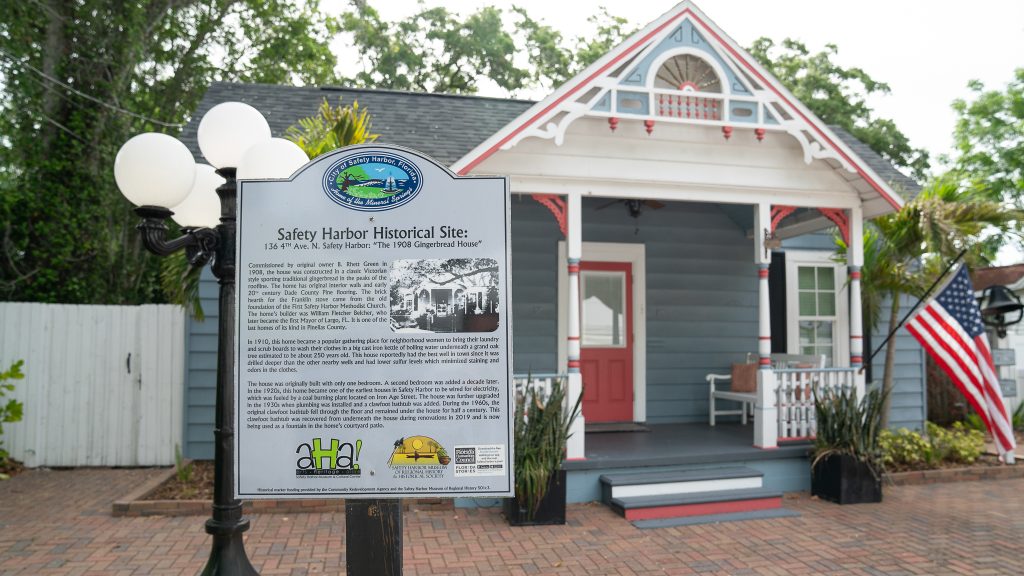
Of all the homes I’ve sold in my real estate career, few have taught me more about the architecture, the history, and the real estate economics of Tampa Bay than the small blue-and-white Victorian cottage at 136 4th Avenue North in downtown Safety Harbor. Commissioned in 1908 by B. Rhett Green and his wife Josie, built by William Fletcher Belcher — a major early Pinellas County developer who would later become the first mayor of Largo — and standing today as one of the last intact Victorian Gingerbread homes in Pinellas County, this house has a documented history that stretches across 118 years and three centuries of Florida development.
I’ve had the privilege of representing this home twice. In 2017, I sold it for $374,000 as a historic cottage awaiting its next chapter. In 2020, I sold it again — following a full 2018 restoration that transformed it into a fully realized landmark property — for $1,050,000. In December 2024, the home transacted again for approximately $1,165,000. The appreciation curve tells part of the story, but the appreciation itself is downstream of something more fundamental: this is a home whose value comes from history, architectural rarity, and location in one of Tampa Bay’s most genuinely distinctive small-town downtowns. You don’t sell a home like this on comparable sales. You sell it on story, identity, and provenance.
What follows is the most complete public account of the 1908 Gingerbread House that I’m aware of — drawn from the official Safety Harbor historical marker installed at the property, my own research and experience representing the home, and the architectural evidence of the home itself. If you’ve walked past this corner of downtown Safety Harbor and wondered about the story, here it is.
The Origin: 1908 — B. Rhett Green and William Fletcher Belcher
The home was commissioned in 1908 by B. Rhett Green as a residence for himself and his wife Josie. The year matters: 1908 places the home in the foundational era of Safety Harbor as an incorporated community. The city itself — known then as Green Springs, later as Espiritu Santo Springs for its mineral waters, and finally renamed Safety Harbor in 1917 — was still a small springs-based resort community in the early 20th century, drawing visitors to its healing mineral waters and beginning to transition into the permanent residential town it would eventually become.
The builder — William Fletcher Belcher — is himself a historically significant figure in Pinellas County development. Belcher was one of the early Pinellas County developers during the county’s formative years, and he would later become the first mayor of Largo, Florida. A home commissioned by one early resident and built by a developer who would go on to hold the first mayoral office of a neighboring incorporated city is not a minor piece of real estate. It’s a piece of regional political and developmental history made visible in architecture.
The home was built in a classic Victorian style with the decorative “gingerbread” detailing that gives the property its enduring nickname. Original interior walls survive to this day, as does the early 20th century Dade County Pine flooring — a material so historically specific that it deserves its own explanation. Dade County Pine (also called Miami-Dade Pine) was an old-growth, dense, resin-rich southern pine that grew in specific areas of South Florida and was prized in early Florida construction for its extraordinary durability, natural resistance to termites and rot, and rich golden color. It was harvested nearly to extinction by the mid-20th century, and today it is essentially unavailable except through reclamation from demolished historic homes. A home with original Dade County Pine flooring from the early 1900s has something that cannot be reproduced at any price.
The home’s original brick hearth — built for a Franklin stove, the iron stove that predated central heating in most early Florida homes — came from the old foundation of the First Safety Harbor Methodist Church. This detail is worth pausing on: the home was built in part from salvaged materials from an earlier demolished Safety Harbor building, which means the home is not just a 1908 artifact but also contains within its fabric pieces of an even older Safety Harbor structure. The house is, in a real sense, a layered archaeological record of the town.
The Gingerbread House: What Victorian Gingerbread Architecture Actually Is
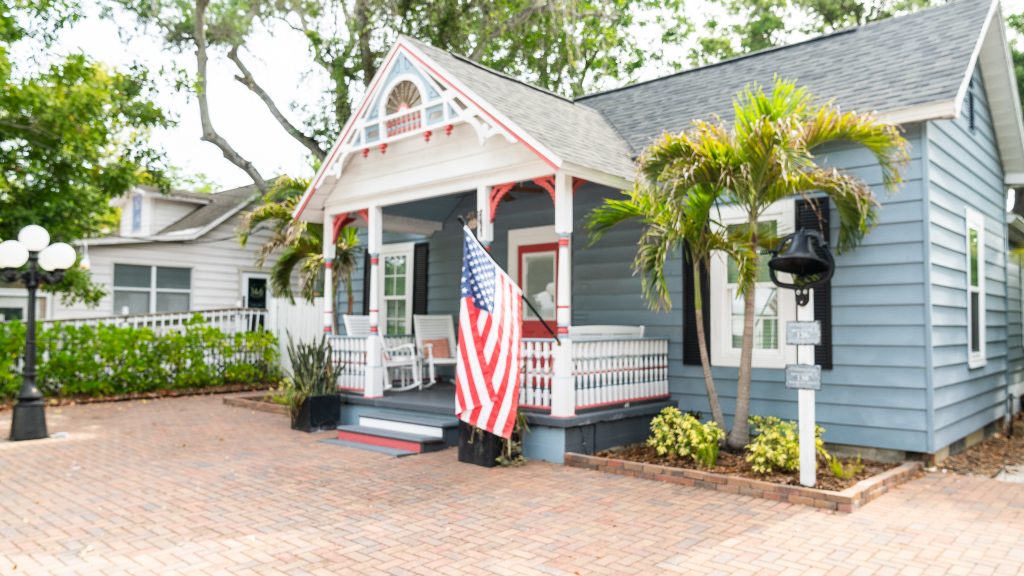
The “Gingerbread House” nickname isn’t marketing — it’s a technically correct architectural description. Gingerbread architecture refers to the intricate decorative wood trim — often including fretwork, spandrels, brackets, and scrollwork — that characterized late-19th and early-20th century Victorian residential design, particularly within the broader Folk Victorian and Carpenter Gothic traditions. The name comes from the resemblance of the decorative scrollwork to the icing patterns on a gingerbread house.
This specific home displays the classic Gingerbread elements clearly:
- Steeply pitched front-facing gable — the defining roof form, providing the dramatic peak that frames the decorative trim work
- Ornate gable ornament — the sunburst pattern with spindle work visible in the peak of the gable, painted in the home’s distinctive color scheme
- Decorative bracket work beneath the gable and porch eaves — the small ornamental elements that give the home its signature “gingerbread” character
- Turned spindles and balusters on the porch railings
- Pointed pickets on the porch railing echoing the gable peak
- Classic blue-gray body color with red and white trim — a traditional Victorian painting convention (“painted lady” tradition) where multiple colors are used to articulate architectural details
- Symmetrical front porch with simple wood posts supporting a covered entry
- Front-facing gable-end cottage form — a compact, one-story footprint typical of modest late-Victorian cottages built for middle-class residents
Gingerbread and Folk Victorian architecture was popular across the United States from roughly the 1870s through the 1910s. It reached Florida somewhat later than the Northeast and Midwest, and surviving examples in Florida — particularly in coastal Florida, where heat, humidity, and hurricanes have destroyed so much early architecture — are genuinely rare. The Safety Harbor historical marker notes that this home “is one of the last homes of its kind in Pinellas County.” That’s not hyperbole. It’s an accurate statement of architectural scarcity.
For context within Tampa Bay: Craftsman bungalows from the 1910s through 1930s survive in substantial numbers across Seminole Heights, Historic Kenwood, and other neighborhoods. Mediterranean Revival estates from the 1920s survive in concentration on Davis Islands, Snell Isle, and Hyde Park. But intact Gingerbread Victorian cottages from the pre-1910 era — a full decade earlier than most surviving Tampa Bay historic architecture — are scarce enough that each surviving example represents something essentially irreplaceable.
The Home’s Century of Evolution
The historical marker documents a century of thoughtful additions and modernizations, each of which tells part of the story of how Florida homes evolved with the 20th century.
1910: The Community Washing Day Tradition. Just two years after construction, the home became a popular gathering place for neighborhood women who brought their laundry and scrub boards to wash clothes in a large cast iron kettle of boiling water beneath a grand oak tree — estimated even then to be about 250 years old, which would place the tree’s origin in the late 1600s or early 1700s. The home reportedly had the best well in town, drilled deeper than its neighbors’ and with lower sulfur levels that minimized staining and odors in the washing. This small detail — that the home was chosen as the community washing location because its well water was superior — tells you something about how early Safety Harbor actually functioned as a community, and about the home’s specific place within it.
1910s-1920s: Expansion. The home was originally built with only one bedroom. A second bedroom was added approximately a decade after original construction. This is a common pattern in early Florida cottages — families grew, homes expanded, the small footprint gradually enlarged to match changing needs.
1920s: Electrification. The home became one of the earliest houses in Safety Harbor to be wired for electricity, powered by a coal-burning plant located on Iron Age Street. The choice to electrify early signals both the owners’ means and Safety Harbor’s gradual transition from springs-resort community to modernizing town.
1930s: Plumbing and the Clawfoot Tub. Indoor plumbing was installed in the 1930s, along with a clawfoot bathtub — a detail that would later produce one of the home’s most remarkable stories.
1960s: The Falling Tub. During the 1960s, the original clawfoot bathtub fell through the floor and remained under the house for half a century. The tub was forgotten, presumed lost, or simply left where it had come to rest.
2019: The Rediscovery. During the home’s renovation, the clawfoot bathtub was recovered from underneath the house — after more than fifty years beneath the floorboards. It was restored and is now in use as a fountain in the home’s courtyard patio. This is the kind of genuine historical survival that no amount of new construction can replicate. An original 1930s clawfoot tub, installed when indoor plumbing first came to the home, fell through the floor in the 1960s, rediscovered during a 2019 renovation, and now transformed into a working fountain in the courtyard. The tub has been part of the home for nearly a century.
The MLS Record and the “1936” Discrepancy
One detail that anyone researching this home will encounter: public records and MLS data have historically listed the home’s build year as 1936 rather than 1908. This is a common discrepancy in historic home records, and understanding why it happens matters for buyers and for accurate historical documentation.
Property tax records in Florida typically reflect “effective year built” rather than original construction year. When a home undergoes major renovation, substantial addition, or reconstruction work, the effective year built may be updated to reflect the significant improvements rather than the original construction date. The 1908 Gingerbread House has, over its century-plus lifetime, received multiple significant upgrades — the 1910s expansion adding a second bedroom, the 1920s electrification, the 1930s plumbing installation, likely further mid-century work, and the full 2018-2019 restoration. At some point in that timeline, the property record updated to reflect a more recent “effective” date, and 1936 became the officially recorded year.
The historical marker installed at the property by the City of Safety Harbor, the Safety Harbor Museum of Regional History, and the aHa! Arts Heritage Alive organization definitively establishes 1908 as the actual original construction year. For purposes of historical accuracy and for any future listing or sale, 1908 is the correct date. For property tax and insurance record purposes, the county-recorded year may remain 1936 or another date. This is not unusual with historic homes — it’s simply part of the documentation reality and is worth understanding rather than arguing about.
The 2018 Restoration and Transformation
Between my two transactions on this property — my 2017 sale at $374,000 and my 2020 sale at $1,050,000 — the home underwent the full restoration that established its current identity.
The 2018-2019 work was not a “renovation” in the ordinary sense. It was a restoration project that preserved the home’s original character — the Dade County Pine floors, the interior walls, the architectural detailing, the fundamental Gingerbread identity — while modernizing the systems and reconfiguring portions of the interior for contemporary flexible use. The home was transformed from a historic cottage into a fully realized mixed-use property: residential use for owners who want to live in a landmark home, short-term rental potential for the lifestyle and experience-focused hospitality market, and potential for boutique commercial uses given the home’s location and character.
This transformation — from historic residence to multi-use heritage property — is one of the most significant value-creation models in Tampa Bay historic real estate. A home that can function as a primary residence, a lifestyle rental, a boutique business, or some combination of these has a dramatically larger potential buyer pool than a home restricted to a single use. The value jump from $374,000 in 2017 to $1,050,000 in 2020 reflects not just Tampa Bay’s broader appreciation during that period — though that was real — but specifically the successful transformation of a historic cottage into a landmark asset.
The Transaction History
2017 Sale: $374,000. I represented the transaction at this price point. The home was historically significant but had not yet undergone the full restoration that would establish its current identity. The price reflected the home’s condition at that moment — a landmark-quality Gingerbread cottage with genuine restoration potential, sold to a buyer, Rhonda Harms, who recognized what it could become.
2020 Sale: $1,050,000. I represented the transaction again following the completion of the 2018-2019 restoration. The price reflected the home’s transformation: from restoration candidate to fully realized landmark property, with the architectural character preserved, the systems modernized, and the flexible use positioning established.
December 2024 Sale: Approximately $1,165,000. I did not represent this transaction, but the sale is publicly recorded. The price represents modest continued appreciation from the 2020 level, in line with broader Tampa Bay historic real estate appreciation patterns and consistent with the home’s established landmark status. The home is approximately 2,039 square feet with three bedrooms and three bathrooms, though as I’ve written throughout this post, the home’s value is not primarily a function of its square footage.
Why Downtown Safety Harbor Matters
The 1908 Gingerbread House is not a standalone artifact. It is one of the defining properties of downtown Safety Harbor — a small-town downtown that has emerged over the past decade as one of the most genuinely desirable walkable communities in Tampa Bay.
Safety Harbor sits on the northwestern shore of Old Tampa Bay, across the water from Tampa and just north of Clearwater. The town’s identity is defined by several anchors: the Espiritu Santo Springs (the mineral springs that originally drew visitors in the late 19th century), Philippe Park (the 122-acre waterfront park that contains significant pre-Columbian Native American mounds), the historic Safety Harbor Resort and Spa, and Main Street — a short, walkable commercial corridor that has become one of Tampa Bay’s most beloved small-town downtowns.
The 1908 Gingerbread House sits at 136 4th Avenue North, on a corner of the downtown grid that places it within easy walking distance of Main Street’s restaurants, shops, and the Safety Harbor waterfront. For buyers seeking the lifestyle of genuinely walkable small-town living with immediate access to water, dining, and community culture, downtown Safety Harbor is one of the strongest propositions in Pinellas County. The Gingerbread House represents the most architecturally distinctive historic inventory in that market.
Why This Home Sells on Story
I’ll say directly what I tell every client who asks about properties like this one: you don’t sell a home like the 1908 Gingerbread House on comparable sales. You sell it on story, identity, and rarity.
The standard real estate approach — find comparable recently sold homes, adjust for differences in condition and size, arrive at a price — doesn’t work well for properties whose value is primarily a function of uniqueness. There are no true comparables for the 1908 Gingerbread House because there are essentially no other homes of this architectural style, this historical documentation, this specific provenance in Pinellas County. The home’s value is established not by what similar homes have sold for but by what the specific buyer who wants this specific home will pay.
This buyer is not a generic buyer. The buyer for the 1908 Gingerbread House is someone who actively values architectural rarity, documented history, the creative story of a clawfoot tub that fell through a floor and was reclaimed fifty years later, the lifestyle appeal of owning a home featured on a municipally-installed historical marker, and the flexibility of a property that can function as residence, rental, or boutique commercial space. This buyer responds to story-driven marketing, architectural photography, narrative listing copy, and representation that can speak substantively about the home’s full history.
Reaching that buyer requires marketing the home for what it actually is — not a 3-bedroom 3-bathroom cottage of 2,039 square feet, but a 118-year-old landmark Victorian with original Dade County Pine floors, documented provenance tied to early Pinellas County political history, and one of the most completely documented home histories in Tampa Bay.
This is the kind of representation that specialized historic-home agents provide and that generic agents typically don’t. It’s why I’ve been able to represent this home successfully across two transactions and a significant appreciation curve. And it’s why homes like the 1908 Gingerbread House consistently outperform their comparables when the right agent tells their story properly.
The Bigger Picture
Homes like the 1908 Gingerbread House are why I’ve built my practice around historic and character homes in Tampa Bay. They’re also why I believe so strongly in the work of preservation — the maintenance, restoration, and adaptation of architecturally significant homes across generations of ownership.
The 1908 Gingerbread House has been standing for 118 years. It was built by a man who became the first mayor of Largo. It saw Safety Harbor’s transformation from a springs resort town to a modern community. It was electrified in the 1920s, plumbed in the 1930s, survived decades of mid-century change, was fully restored in 2018-2019, and has been transacting at landmark valuations ever since. It contains pieces of an even older Safety Harbor church foundation. It contains a recovered 1930s bathtub that spent half a century beneath its own floor.
Every owner who has stewarded this home has added to its story without erasing what came before. That’s what good historic home ownership looks like. And it’s why the home, a century from now, will likely still be standing — still beautiful, still distinctive, still telling the story of how Pinellas County actually came to be.
Considering a Historic Home Purchase in Safety Harbor?
If you’re considering a historic home in downtown Safety Harbor — or anywhere across Tampa Bay — I’d be glad to have the conversation. I’ve built my practice specifically around homes like the 1908 Gingerbread House: properties where history, architectural rarity, and story-driven value require specialized representation rather than standard comparables-based listing.
Whether you’re a buyer seeking a landmark property, an investor considering a mixed-use heritage asset, or an owner of a historic Safety Harbor home considering its future, I’d welcome the opportunity to discuss your goals.
Call 727-871-SOLD (727-871-7653) or reach out through the Contact page to start the conversation.