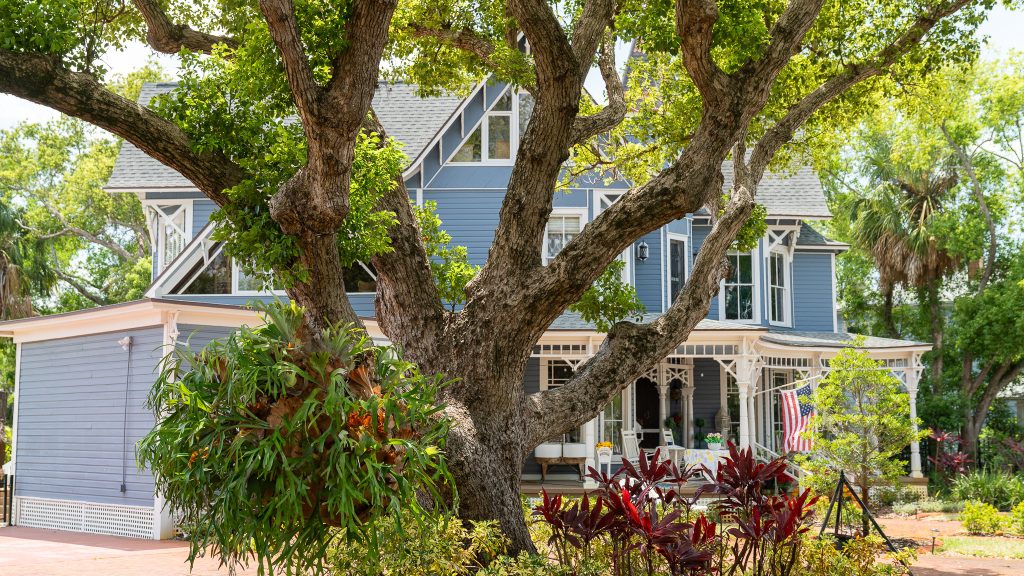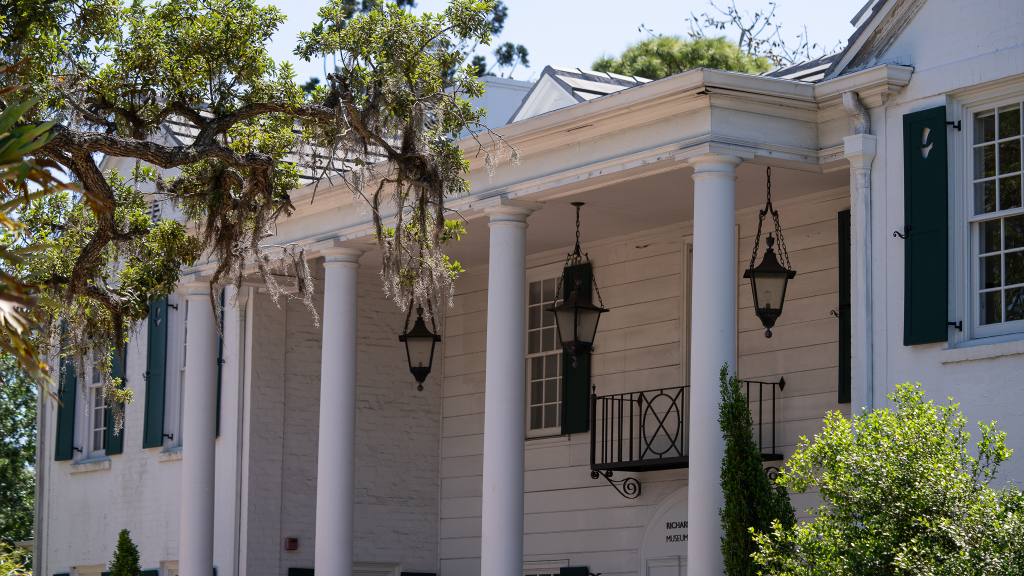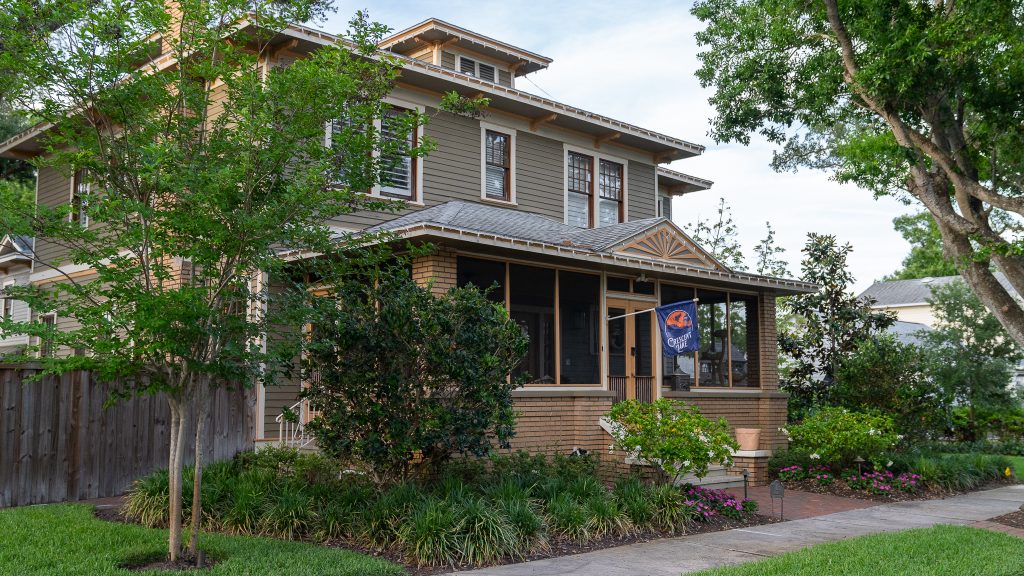
very once in a while in this work, I find myself standing in front of a home so genuinely consequential that the professional parts of my brain go quiet and I just look. The Knapp House at 115 S Spring Boulevard in Tarpon Springs — the three-story Queen Anne Revival overlooking Spring Bayou, its curved front porch giving it the local name “Crescent House” — is one of those homes.
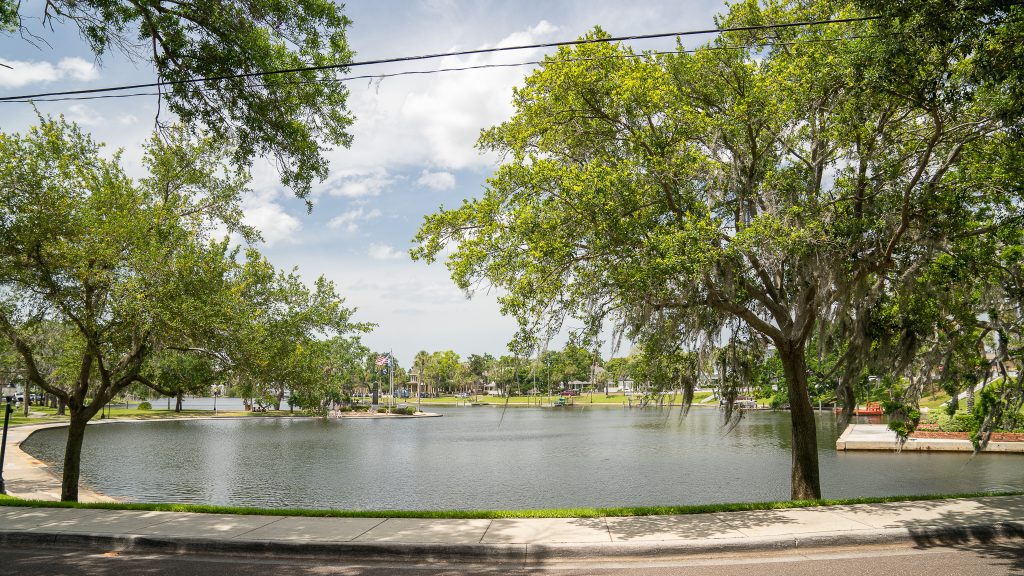
I photographed it yesterday, walking South Spring Boulevard as the light softened into late afternoon, Craig Park across the street, the bayou beyond. I’ve known the home for years. Every historic-home specialist working in North Pinellas County knows this home. But I wanted to take my own photographs, walk the property boundary slowly, and spend time with a house that is, by several widely-cited accounts, one of the oldest frame homes still standing in Pinellas County — and arguably the single most historically significant residence in Tarpon Springs.
The story of this house is the story of Tarpon Springs itself. And what follows is the most complete account of it I’ve been able to assemble from primary historical sources, period documentation, architectural survey records, and decades of local knowledge.
A Home Older Than the City Itself
The Knapp House predates the incorporation of Tarpon Springs. That alone places it in rare company.
The Florida Master Site File — the official archaeological and historical resources inventory maintained by the Florida Division of Historical Resources — documents the home as site 8PI238, formally recorded as the “Edward Newton Knapp House” at 115 S Spring Boulevard, with a construction date of circa 1886 and an architectural classification of Queen Anne Revival. Local sources including the Tampa Bay Times, Creative Loafing, and the Tarpon Springs Area Historical Society have variously cited construction dates ranging from 1884 to 1886, reflecting the natural imprecision of records from an era when many Florida homes were built without formal permits or dated documentation.
What matters is that all credible sources place the home’s construction in the mid-1880s — meaning the house was standing before Tarpon Springs became a legally incorporated city. On February 12, 1887, Tarpon Springs became the first incorporated city in what is now Pinellas County. The meeting that incorporated the city was, according to multiple historical accounts including the St. Petersburg Times reporting by Katherine Gazella, held in the Knapp House itself — possibly in the home’s living room — with Edwin Knapp presiding.
Think about what that actually means. Before Pinellas County separated from Hillsborough County in 1912. Before Tarpon Springs had a formal municipal government. Before the railroad arrived in 1887 connecting the town to the broader American economy. Before the Greek sponge-diving community established the industry that would define the city for more than a century — the Knapp House was already standing on Spring Bayou. And the men who met in this home to formally create the city of Tarpon Springs were, in a literal sense, founding the community from its walls.
For buyers and historic-home enthusiasts accustomed to Tampa Bay’s abundance of 1920s Craftsman bungalows and 1930s Mediterranean Revivals, this distinction matters. The Knapp House is architecturally, historically, and civically older than nearly every other surviving residential property in the region.
Edwin Knapp: The Kansas Hardware Tycoon Who Helped Build Tarpon Springs
A note on the name before going further. The Florida Master Site File records the home as the “Edward Newton Knapp House.” Real estate listings, local historical society materials, and the St. Petersburg Times reporting have generally used “Edwin H. Knapp” or “Edwin Knapp.” Both names appear in credible sources, and without access to original handwritten census or property records, resolving the discrepancy definitively is outside the scope of this post. What all sources agree on is that a man named Knapp, identified as a Kansas hardware tycoon and one of Tarpon Springs’ founding figures, commissioned and presumably oversaw the construction of this home in the mid-1880s. Throughout this post I will refer to him as Knapp, with the period-appropriate “Edwin” in specific historical contexts where that name is most widely attested.
Knapp’s role in early Tarpon Springs was not incidental. He presided over the meeting that incorporated the city. His home became a gathering place for the community’s civic and social life. And the fact that the Knapp House today remains a landmark residence on Spring Bayou, rather than a house lost to demolition or fire or neglect, reflects the specific prominence and permanence that Knapp’s era represented.
The broader founding cast of Tarpon Springs is worth understanding to place Knapp in context. The city’s acknowledged founder — and the figure whose role has received the greatest historical attention — was Anson P.K. Safford, a former governor of the Arizona Territory who came to Tarpon Springs as president of Hamilton Disston’s Lake Butler Villa real estate development company. Safford’s home, now preserved and operated as a museum by the City of Tarpon Springs, sits about half a mile from the Knapp House on Parkin Court. The Florida Master Site File records the Safford House (8PI176) as dating to circa 1883 — making it possibly two or three years older than the Knapp House, and one of the very few surviving Pinellas County residences definitively older.
Safford, Knapp, John King Cheyney (who would establish the Tarpon Springs sponge industry), and a small cohort of Northeastern and Midwestern investors and winter residents together shaped what Tarpon Springs would become. Their homes — those that survive — line the streets around Spring Bayou today, forming one of the most architecturally significant concentrations of 1880s and 1890s residential architecture in the entire state of Florida.
Queen Anne Revival: Understanding What You’re Looking At
The Knapp House’s architectural style is Queen Anne Revival, and if you want to understand what makes this home distinctive beyond its age, the architecture tells the story.
Queen Anne is the most elaborate and decoratively ambitious of the major late-19th-century American residential styles. It dominated high-end American residential architecture from roughly 1880 to 1910 and is characterized by several defining features, most of which are clearly visible on the Knapp House:
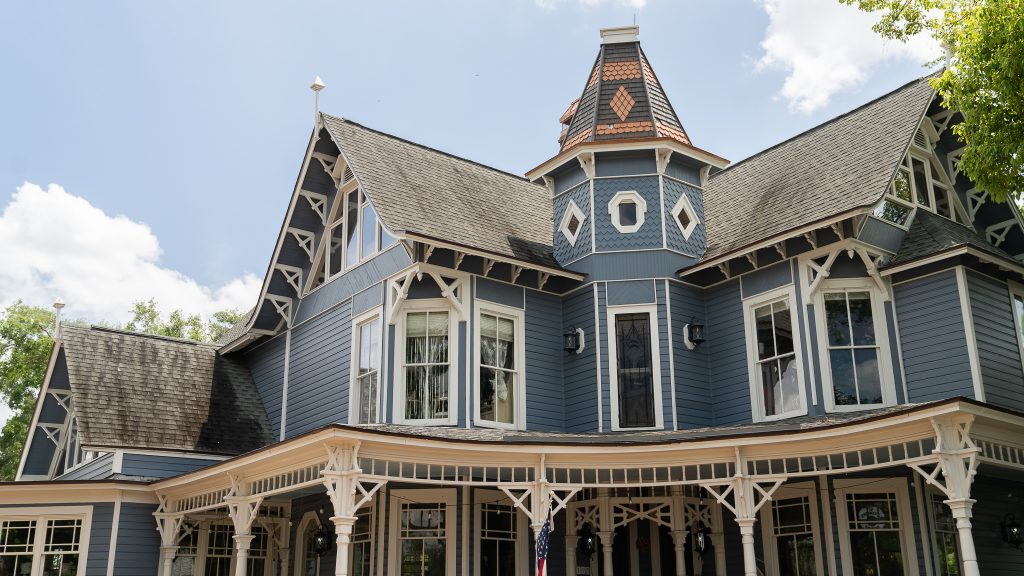
Asymmetrical massing. Queen Anne homes reject the classical symmetry of earlier American residential styles in favor of complex, irregular compositions — towers on one side, bay windows on another, porches wrapping unevenly around the facade. The Knapp House’s three-story massing and its distinctive curved (crescent-shaped) front porch, from which the home takes its local nickname, exemplify this Queen Anne asymmetry.
Complex rooflines. Multiple gables, turrets, and roof planes interact in ways that create visual richness from every angle. The Knapp House’s multi-gabled roof, with its steep pitches and decorative millwork, is textbook Queen Anne.
Variety of surface materials and textures. Queen Anne homes typically combine clapboard siding, shingles in decorative patterns (fish-scale, diamond, octagonal), decorative trim work, and often stone or masonry accents. The Knapp House features multiple siding treatments and decorative woodwork in its gable ends.
Ornamental detailing. Turned spindles, decorative brackets, fretwork, stained glass, and elaborate porch detailing are hallmarks of the style. The Knapp House retains original stained glass windows — a genuinely rare survival for a home of this age — along with elaborate porch spindle work and decorative exterior trim.
Generous porches. The Queen Anne tradition embraces the porch as both functional outdoor living space and architectural centerpiece. The Knapp House’s signature curved porch, the source of the “Crescent House” name, is one of the most photographed architectural features in all of Tarpon Springs.
Queen Anne Revival homes were genuinely expensive to build in the 1880s. The complex rooflines, the decorative millwork, the mixed siding treatments, the custom stained glass — all required skilled craftsmanship at a premium. A Queen Anne home of this scale in 1886 Tarpon Springs was a serious architectural statement. It signaled wealth, permanence, and cultural seriousness in a town that was itself less than five years from its earliest organized development.
The Material Record: 37 Hardwoods, Heartwood Pine, and Irreplaceable Craftsmanship
One of the most documented and celebrated aspects of the Knapp House is its extraordinary use of Florida hardwoods in the original interior construction. According to widely-repeated accounts in real estate listings, newspaper features, and historical tour materials, the home incorporates approximately 37 different varieties of Florida hardwoods throughout its interior — some of which are now extinct or commercially unavailable.
The floors are heartwood pine. The walls and ceilings feature accents in burl pine, cypress, and other specialty native hardwoods. The interior millwork reflects the kind of artisan craftsmanship that simply cannot be reproduced today at any price — not because contemporary craftsmen lack skill, but because the old-growth timber that defined late-19th-century Florida interiors is largely gone.
Heartwood pine, in particular, deserves its own recognition. “Heartwood” refers to the dense, resin-rich inner core of mature pine trees — wood harvested from trees that had grown for 100 to 300 years, producing a density and durability that second-growth pine simply cannot match. The heartwood pine in the Knapp House was harvested from trees that had been growing since the 1500s and 1600s. The wood in this home is, in a literal sense, older than the United States.
The double-sided fireplace, original stained glass windows, and period architectural details throughout the interior together represent one of the most intact original interiors of any 1880s home in Pinellas County.
The 1970s Restoration: Donald Scholl and the Work That Saved the Home
Between its 1880s construction and the 1970s, the Knapp House passed through multiple owners and periods of varying care. By the 1970s, the home had fallen into significant disrepair. That the house survives today in its restored condition is largely the work of one man: Donald Scholl.
Scholl, a local Tarpon Springs attorney, purchased the Knapp House in 1976. The restoration that followed — which he undertook beginning in 1978 and which reportedly took approximately three years — was extraordinary in scope. Scholl removed the entire interior finish down to the exterior walls, allowing comprehensive replacement of insulation, electrical wiring, and plumbing systems. He then rebuilt the interior using drywall and plaster finishes, modernizing the home’s functional systems while preserving the original architectural character, the original hardwood elements, the original stained glass, and the defining features that make the home what it is.
This is the kind of restoration that separates landmark preservation from cosmetic renovation. Scholl did not simply repaint and replace visible finishes. He rebuilt the home’s systems from the ground up while protecting its irreplaceable historic character. The approach represents something closer to what preservationists call “rehabilitation” in the Secretary of the Interior’s Standards framework — modernizing for contemporary use while preserving significant historical features.
Because of Scholl’s work, the Knapp House today has modern electrical, plumbing, and insulation systems behind walls that still contain the artisan woodwork of the 1880s. The heartwood pine floors that were original to the home remain. The stained glass windows remain. The double-sided fireplace remains. The curved porch remains. The home functions as a comfortable contemporary residence while retaining the material fabric of a house that predates Tarpon Springs itself.
This transformation is why the home has remained a featured stop on the annual Tarpon Springs historic home tour for decades, why it has been the subject of countless newspaper and magazine features over the years, and why it is, as local historical materials note, “the most photographed home in Pinellas County.”
The Setting: Spring Bayou and the Heart of Historic Tarpon Springs
The Knapp House doesn’t sit on any corner of Tarpon Springs. It sits on South Spring Boulevard, directly across from Craig Park, overlooking Spring Bayou — the geographical and cultural heart of historic Tarpon Springs.
Spring Bayou is where Tarpon Springs began. The early settlers who arrived in the 1870s and 1880s built their homes on and around the bayou because it offered sheltered water access, fresh spring-fed inlets, and natural beauty that drew wealthy Northeastern winter residents throughout the late 19th century. The Victorian-era homes that line Spring Bayou’s banks today — including the Knapp House — are the surviving vestiges of Tarpon Springs’ original identity as a winter resort community.
Craig Park, directly across from the Knapp House, is itself a historic civic space. The park hosts the annual Tarpon Springs Arts and Crafts Festival, the Christmas Boat Parade, and — most famously — the Greek Epiphany celebration each January 6th. During the Epiphany ceremony, the Metropolitan of Atlanta (sometimes joined by the Archbishop of America) leads a procession from St. Nicholas Greek Orthodox Cathedral to Spring Bayou, where boys ages 16 to 18 dive into the water to retrieve a wooden cross thrown by the Metropolitan. Whoever recovers the cross is said to be blessed for a full year. The ceremony draws thousands of visitors annually and is one of the largest and most authentic Greek Orthodox Epiphany celebrations in the Western Hemisphere.
The Knapp House, with its curved porch overlooking the bayou, has been a silent witness to every one of these celebrations for more than a century.
Beyond Craig Park, the Knapp House’s location places it within immediate walking distance of the historic downtown Tarpon Springs commercial district — the restaurants, shops, and craft breweries of Tarpon Avenue and Pinellas Avenue — and within a few minutes of the legendary Tarpon Springs Sponge Docks, the center of the Greek sponge-diving community that transformed the city beginning in 1905.
There is no residential address in Tarpon Springs more intimately tied to the city’s history and cultural identity than 115 S Spring Boulevard.
The Market Record
The Knapp House has transacted infrequently — as homes of this significance typically do — and each transaction has been a notable event in North Pinellas real estate.
The home was most recently sold on August 15, 2024, for $1,425,000, following a listing period that began in October 2023 at an original asking price of $1.9 million. The 2023-2024 listing was featured in multiple Tampa Bay and Florida media outlets, including Creative Loafing Tampa Bay, the St. Pete Catalyst, and various architectural and historic-home publications — reflecting the home’s status as a legitimately newsworthy property whenever it changes hands.
According to current public records and listing history, the home contains approximately 4,064 square feet across three stories, with four bedrooms and three bathrooms. The property is situated on a corner lot across from Craig Park with direct views of Spring Bayou.
For any future buyer considering a property of this historical weight, the standard real estate economics don’t really apply. Homes like the Knapp House are not priced on comparable sales because there are essentially no comparables. There is one Knapp House in Tarpon Springs. There is no second one, and no similar home will ever be built.
Why This Home Matters Beyond Tarpon Springs
I want to step back for a moment and make a broader point about what homes like this one mean for Tampa Bay’s built heritage.
The Knapp House is not just a beautiful Victorian home in Tarpon Springs. It is a physical record of how Pinellas County came to exist. The incorporation meeting held within its walls in 1887 set in motion the municipal governance structure that would eventually give rise to the county itself. The architectural decisions made by Knapp and his builders in 1886 established a standard of craftsmanship, material quality, and civic ambition that influenced the Spring Bayou district and, through it, the broader character of early Tarpon Springs development.
When we lose homes like this — to fire, to storms, to demolition, to gradual neglect — we don’t just lose buildings. We lose the physical anchor points that make our region’s history tangible. A community can read about its founding in books and archives, but those accounts remain abstract until you can stand on a particular corner, look at a particular home, and know that the people who created your city met in that room, on that floor, under that roof.
The Knapp House has been extraordinarily fortunate in its stewardship. Donald Scholl’s 1970s restoration kept the home from following the fate of so many 19th-century Florida residences. Every subsequent owner has continued that work. The current residents of this home are stewards of something that cannot be replaced, and they carry the same responsibility that Edwin Knapp himself carried when he commissioned the construction in the mid-1880s: to build and maintain something that will stand.
For anyone who loves historic homes, who buys and sells them, who studies their architecture, or who simply believes that the past matters — homes like the Knapp House are the most important inventory we have.
Thinking About Historic Tarpon Springs?
The Spring Bayou district of Tarpon Springs contains one of the most significant concentrations of 1880s and 1890s residential architecture in Florida. The Knapp House is the most famous, but it is not alone — the Safford House, the William T. Fleming House at 22 N Spring Boulevard, the Marshall H. Alworth House at 144 N Spring Boulevard, the Rev. Miles Standish House at 127 S Spring Boulevard, and dozens of other documented early residences form one of Florida’s most architecturally important historic districts.
If you’re considering the purchase of a historic home in Tarpon Springs, or anywhere else in Pinellas County where architectural significance and provenance affect value — or if you’re an owner of such a home considering its future — I’d welcome the conversation. Historic homes of this quality deserve representation that understands what they actually are.
Call 727-871-SOLD (727-871-7653) or reach out through the Contact page to start the conversation and visit me on my main site www.middletontampabay.com