Some neighborhoods reveal themselves slowly. You drive past them on your way to somewhere else, perhaps for years, until one afternoon you turn off the main road and understand, all at once, what you have been missing. Crescent Lake, in the heart of historic St. Petersburg, is that kind of neighborhood.
Located roughly a mile north of downtown, bounded by 4th and 9th Streets North and anchored by the 54-acre Crescent Lake Park, this quiet district of approximately 550 homes represents one of the most architecturally coherent and culturally distinguished historic neighborhoods in all of Tampa Bay. Its streets are lined with 1920s Craftsman bungalows, Tudor Revival cottages, Mediterranean Revival estates, Colonial Revival homes, and the occasional Art Deco or early Ranch residence. Its sidewalks are hex-block in some sections, brick-paved in others, shaded by oak and palm canopies that have been growing above these streets for most of a century. Its lake — an actual, unambiguously beautiful 54-acre lake — is the kind of natural amenity that no contemporary developer could engineer at any price, because it predates the city itself.
And perhaps most importantly for buyers evaluating the Tampa Bay market in late 2025, Crescent Lake sits on meaningfully higher ground than much of coastal St. Petersburg — a distinction that has quietly become one of the single most important factors in the city’s post-Helene residential market. The buyers who understand what Crescent Lake represents are, increasingly, the buyers who are writing the strongest offers on its inventory.
This is a neighborhood worth understanding at depth. What follows is the definitive guide.
The Land Before the Streets
The story of Crescent Lake begins before any of its homes. The lake itself is ancient — a natural freshwater body that predates European settlement by centuries. In 1924, during early development work along its shores, a cypress dugout canoe was dredged from the lake bed. The canoe, subsequently preserved and now held by local museum collections, has been dated to approximately 1800, making it physical evidence of Native American presence and activity in what is now central St. Petersburg more than two centuries ago.
This is a detail that reveals something about the neighborhood’s character. Crescent Lake is not a developer’s invention. It is a natural feature of the landscape that attracted human settlement for generations before any European laid claim to the surrounding land. The neighborhood built around it in the early twentieth century inherited, rather than created, the defining geographic asset that continues to define daily life here today.
European-descended settlement came in the 1870s and 1880s, when the land surrounding the lake was put to agricultural use, primarily citrus cultivation. The area remained grove country — orange and grapefruit orchards stretching across what is now dense urban fabric — until the opening decades of the twentieth century, when the arrival of modern transportation infrastructure transformed the economic logic of the land.
The Streetcar That Changed Everything
The decisive moment came in 1914, when a streetcar line was extended along 9th Street North all the way to 34th Avenue. This is the kind of detail that is easy to overlook a century later but was economically transformative in its moment. A streetcar connection to downtown St. Petersburg meant that land formerly suitable only for agriculture became genuinely valuable residential property. Farmers with citrus holdings suddenly held potential subdivisions. Developers with capital and vision began acquiring parcels. Subdividing started, and Crescent Lake as a residential neighborhood began to take form.
The foundational years of the neighborhood’s construction ran from roughly 1914 through the late 1930s, with a concentrated boom during the Florida Land Boom of 1920 through 1926. Homes from this period — the bungalows, the Tudors, the Mediterraneans, the Colonials — form the architectural core of the neighborhood today. A second wave of construction after World War II filled in remaining lots with Minimal Traditional and early Ranch-style homes, particularly along sections closer to the lake itself.
This chronology matters because it places Crescent Lake within the most celebrated era of American residential architecture. The 1910s through 1930s represent the final sustained period in which American residential construction was defined by handcraft, architectural variety, material quality, and close attention to the relationship between homes and their surrounding streetscape. What Crescent Lake preserves is the residential fabric of that era in nearly complete form.
Perry Snell and the Vision That Became the Park
No figure looms larger over Crescent Lake’s development than Charles Perry Snell, the master developer whose name is more commonly associated with Snell Isle — the luxury waterfront neighborhood he created three miles to the east. Snell’s influence on Crescent Lake is less well known but genuinely significant.
The 54-acre Crescent Lake Park that defines the neighborhood today exists because Perry Snell had the foresight to acquire and hold the parcels necessary to create it. Snell purchased the land surrounding the lake across multiple transactions during the 1910s and 1920s and held them, without immediate development, until the City of St. Petersburg was in a position to acquire the property for public use. The park formally opened in 1927 as a result of this patient stewardship.
This is not a small detail. In the speculative real estate culture of 1920s Florida, a developer choosing to hold prime lakefront property for eventual public parkland rather than subdivide it for maximum immediate return was genuinely unusual. Snell’s vision — that the neighborhood’s long-term value would be enhanced, not diminished, by protecting the lakefront as a public amenity — has been vindicated across a century of subsequent development. Homes in Crescent Lake today derive substantial value from their proximity to the park. That value exists because Snell chose to create the park rather than the lots it replaced.
The park opened with amenities that reflected the ambitions of 1920s civic design. Walking paths circled the water. Landscaped gardens softened the transitions between lake and street. Benches and gathering places invited the public life that the neighborhood’s residents had come to expect. And in a decision that would imprint the park on American sports history, the city built a ballfield at the south end — a ballfield that would soon become one of the most celebrated sites in baseball.
When the Yankees Played on the Lake
Huggins-Stengel Field, at the south end of Crescent Lake Park, served as the spring training home for the New York Yankees from 1925 through 1961. For thirty-six years, the most storied franchise in American professional sports trained each February and March at the south edge of what was then a quiet residential neighborhood in central St. Petersburg.
The roster of players who worked on that field reads as a summary of twentieth-century baseball. Babe Ruth trained at Huggins-Stengel during the prime of his career and during some of his most legendary seasons. Lou Gehrig played there. Joe DiMaggio trained there. Mickey Mantle arrived in the early 1950s. Yogi Berra, Whitey Ford, Casey Stengel (the field’s namesake), Miller Huggins (the other namesake and longtime Yankees manager), and dozens of other Hall of Fame and near-Hall of Fame figures passed through Crescent Lake over the Yankees’ three and a half decade tenure.
For the neighborhood, this is not simply a historical footnote. It is part of the texture of how the residents of the era lived. The Crescent Lake Apartments at 605 24th Avenue North reportedly served as housing for some of the players during spring training. Local residents would attend practices and games. Children would seek autographs. The presence of these figures — whose cultural significance has only grown with time — embedded itself in the neighborhood’s identity in ways that outlasted the Yankees’ eventual departure.
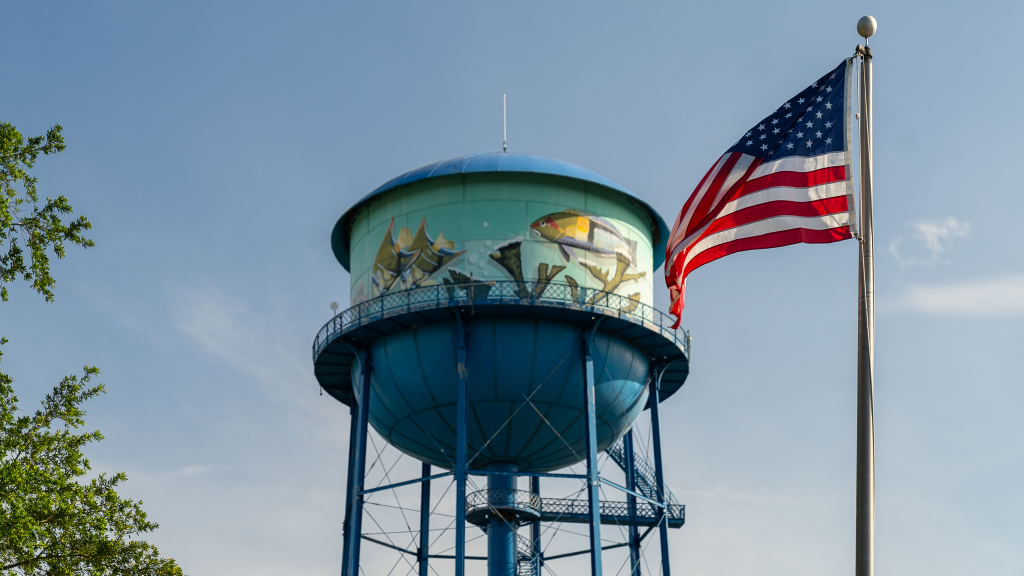
The field continues to serve as a working ballpark today, used by various local and professional teams. The 1923 water tower at the field’s south end, rising above the palm canopy and recently repainted by local muralist Tom Stovall as a trompe-l’oeil saltwater aquarium, remains the neighborhood’s most recognizable visual landmark. Standing at the base of that water tower on a quiet afternoon, with the field stretching away toward the lake and the 1920s homes visible through the trees, it is possible to feel — quite directly — the continuity between the neighborhood of Babe Ruth’s era and the neighborhood of today.
The Architectural Landscape
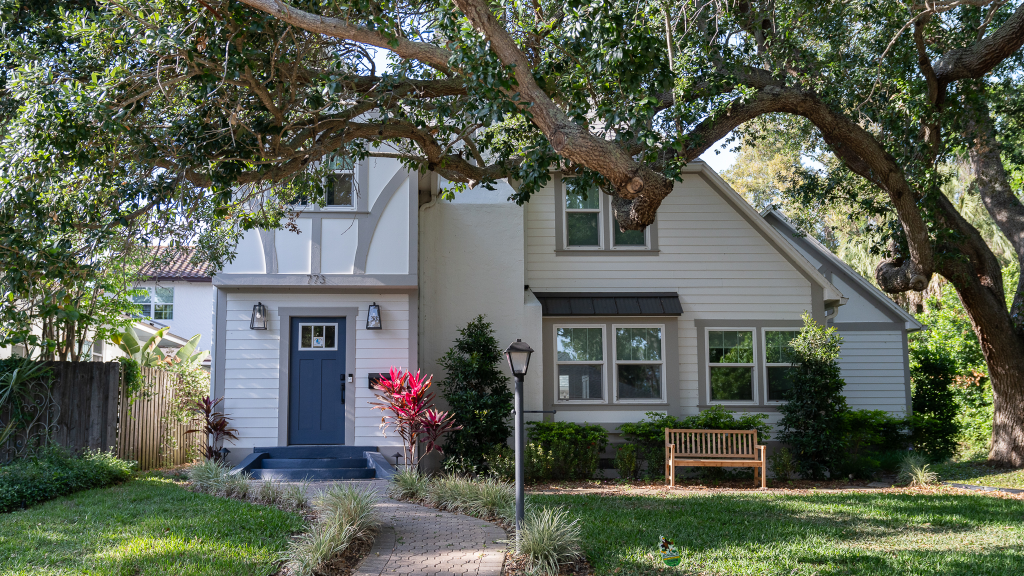
Crescent Lake’s approximately 550 residences represent what may be the most architecturally varied historic neighborhood in St. Petersburg. The styles present in the district include:
Craftsman bungalows form the largest single category of historic housing stock. These 1920s homes, generally between 1,200 and 2,000 square feet, feature the signature Craftsman elements — low-pitched gabled roofs with wide overhangs, exposed rafter tails, tapered columns on stone or brick piers, deep front porches, multi-pane double-hung windows, and interior hallmarks including built-in cabinetry, original longleaf pine or oak flooring, and masonry fireplaces. The Craftsman bungalow was the dominant middle-class residential style of the 1910s through early 1930s, and Crescent Lake’s collection represents the style at its mature best.
Tudor Revival homes appear in concentration along 8th Street, where a particularly fine collection of 1920s Tudors gives the neighborhood one of its most distinctive architectural signatures. These homes, characterized by steeply pitched roofs, decorative half-timbering, prominent chimneys, arched doorways, and leaded glass windows, represent a style that was far more common in the Northeast and Midwest than in Florida during the boom era. Their concentrated presence in Crescent Lake reflects the cultural ambitions of the neighborhood’s early residents, many of whom came from Northern cities and brought their architectural preferences with them.
Mediterranean Revival estates appear in scattered distribution throughout the neighborhood, with several particularly strong examples along the streets closest to the lake. These homes — with their red barrel tile roofs, stucco exteriors, arched entryways, ornamental tile work, and decorative wrought iron — represent the signature Florida boom-era luxury style and would be architecturally at home in Snell Isle, Davis Islands, Hyde Park, or any of the region’s premier historic neighborhoods.
Colonial Revival homes contribute another substantial share of the neighborhood’s historic fabric. Characterized by symmetrical facades, centered entries with classical detailing, multi-pane windows with shutters, and traditional interior layouts, these homes appeal to buyers drawn to the formal architectural vocabulary of the Atlantic Seaboard.
American Foursquare residences — the distinctive boxy two-story homes with hipped roofs and centered dormers — appear throughout the neighborhood, offering substantial historic square footage in a form that accommodates family living better than many of the smaller bungalows.
Art Deco and early modernist homes are rarer but present, reflecting the architectural transitions of the 1930s. Along 4th Street, the neighborhood’s commercial corridor, a collection of Art Deco automobile-era commercial structures adds another layer to the architectural vocabulary.
Early Ranch-style homes from the late 1930s and early 1940s appear along sections closer to the lake, representing the early emergence of what would become the dominant postwar residential style.
Later infill and new construction has filled gaps and replaced some earlier homes over the subsequent decades, with particularly active construction in the early 2000s and continuing today. The best of this new construction respects the neighborhood’s scale, setbacks, and stylistic vocabulary. The less thoughtful examples do not, and form one of the ongoing tensions in the neighborhood’s evolution.
The cumulative effect of this architectural variety, concentrated within a compact and walkable district, is one of the qualities that sets Crescent Lake apart from newer or less historically significant Tampa Bay neighborhoods. Individual homes are interesting; the collection is extraordinary.
The Elevation Advantage
Any honest conversation about Crescent Lake in late 2025 must address what has become the central reality of the post-Hurricane Helene Tampa Bay market: elevation matters more than it has at any point in modern St. Petersburg history.
Helene made landfall in September 2024. In the aftermath, the Tampa Bay residential market bifurcated in ways that continue to shape buyer behavior more than a year later. Neighborhoods that flooded, or that sit substantially in high-risk FEMA flood zones, have seen pricing pressure, extended days on market, and in some segments genuine value resets. Neighborhoods that remained elevated and dry — particularly those substantially within FEMA Flood Zone X where no flood insurance is required — have become increasingly valuable, with premium pricing that reflects the real and quantifiable risk reduction they offer.
Crescent Lake sits on some of the highest natural ground in St. Petersburg’s historic inland neighborhoods. Many sections of the district are in FEMA Flood Zone X. The neighborhood did not experience the widespread storm flooding that affected coastal and lower-lying parts of the city. For buyers evaluating historic St. Petersburg real estate in late 2025, this is not an abstract consideration. It is, for many buyers, the consideration.
The economic implications are straightforward. A Crescent Lake bungalow with documented Flood Zone X status, no prior flood damage, and standard insurance availability represents a fundamentally different ownership proposition than an architecturally comparable home in a high-risk coastal zone. The first carries insurance costs and risk exposure consistent with inland historic real estate. The second carries the premium costs, underwriting constraints, and long-term uncertainty that have come to define coastal Florida ownership. Both homes may be beautiful. The financial profiles are not equivalent.
For buyers specifically seeking the character of 1920s St. Petersburg architecture without the post-Helene complications that affect waterfront and lower-lying neighborhoods, Crescent Lake offers what may be the single strongest combination of historic character and elevated position available in the city.
The Lifestyle of Living Here
Statistics and architectural descriptions can only convey so much. What Crescent Lake actually offers its residents is a specific way of living that has become exceedingly rare in American suburban development.
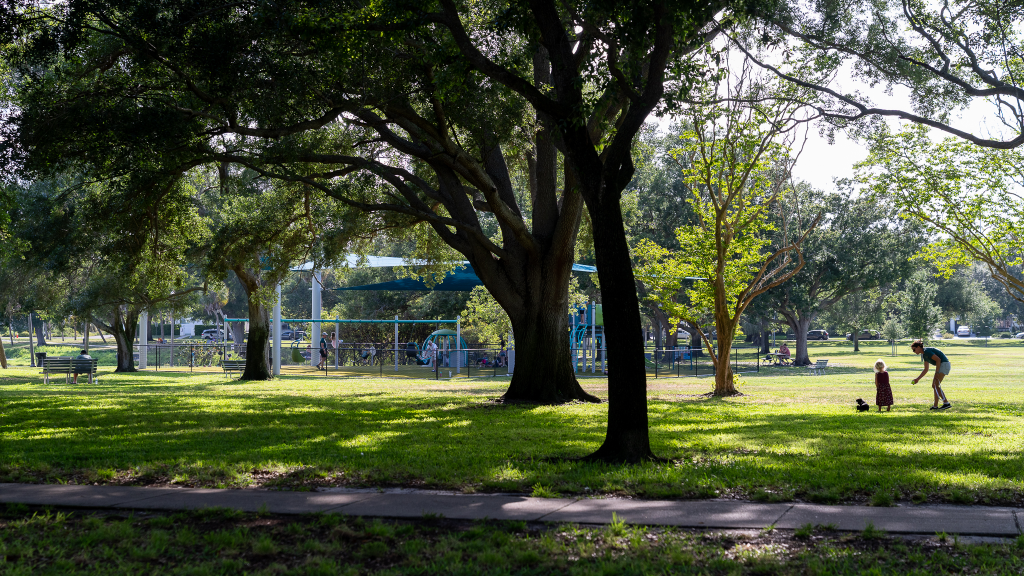
Mornings in the neighborhood begin with walks around the lake. The one-mile perimeter path accommodates joggers, cyclists, dog walkers, stroller-pushing parents, and the steady flow of residents who have made this walk part of the rhythm of their lives. The park’s tennis courts, pickleball courts, and basketball courts fill quickly on weekends. The dog park — divided between large and small dogs — is a genuine community gathering place. The playground, a favorite of neighborhood families, hosts generations of children at the foot of century-old trees.
Afternoons stretch across front porches. The deep Craftsman porches and the columned facades of the Mediterraneans and Colonials were designed for this kind of use — the informal social life of front-yard neighbors who happen to see each other on the way to the mailbox, the intentional sit-down conversation over iced tea as the afternoon cools, the children of different households drifting between front yards while adults talk. This is not an aesthetic, although it photographs beautifully. It is how residents of the neighborhood actually live.
Evenings bring walkable access to the full vitality of downtown St. Petersburg. The downtown commercial core — with its restaurants, galleries, theaters, and the Dali Museum, Museum of Fine Arts, and other cultural institutions — sits a mile south, easily reachable by bike, by car, or by walking with intention. Beach Drive’s restaurants, the St. Pete Pier, and the waterfront parks are minutes away. The Sunken Gardens, one of Florida’s oldest roadside attractions and now a civic institution of genuine significance, is adjacent to the neighborhood. 4th Street North, the commercial corridor along the neighborhood’s eastern edge, offers a developing collection of local restaurants, antique shops, specialty retailers, and the walkable commercial life that complements the residential quietude.
The neighborhood association, active and engaged, organizes community events throughout the year — informal gatherings at the park, seasonal celebrations, holiday programming, and the kind of civic participation that distinguishes genuine neighborhoods from collections of houses that happen to share a zip code.
None of this can be replicated in new construction. The combination of architectural character, natural amenity, walkability, scale, social fabric, and accumulated history that defines Crescent Lake requires a century to produce. What exists here now is, quite simply, what a century of sustained residential community looks like when it has been maintained rather than replaced.
The Investment Case
For buyers evaluating Crescent Lake as an investment in addition to a lifestyle choice, the case rests on several specific fundamentals.
Limited supply. The neighborhood contains approximately 550 homes within fixed geographic boundaries. Inventory does not grow; it only changes hands. In any given year, a relatively modest number of homes come to market, and the supply-demand dynamics consistently favor sellers of well-positioned properties.
Architectural irreplaceability. The 1920s housing stock cannot be reproduced at contemporary construction costs. Original longleaf pine floors, original millwork, original architectural detailing, and the quality of materials used during the boom era represent assets that new construction cannot match at any price point. Buyers drawn to these qualities pay premiums for them, and these premiums have demonstrated durability across market cycles.
Location permanence. One mile from downtown St. Petersburg, adjacent to a 54-acre park, and within walking distance of the city’s cultural and commercial core — this location cannot be replicated. Additional land is not available. The fundamental geography of the neighborhood is fixed.
Elevation resilience. Post-Helene market bifurcation has made elevation a premium asset in ways that were not true before September 2024. Crescent Lake’s generally elevated position and Flood Zone X status for many of its properties represents a resilience advantage that the broader Tampa Bay market is actively pricing into transactions.
Walkability and amenity value. The combination of walkable urban access, substantial natural amenity (the lake and park), and residential density approaching but not exceeding comfortable levels represents exactly the kind of neighborhood pattern that both contemporary new urbanist developers and long-term market analysts have identified as most resilient to changing market conditions.
Price range accessibility. Crescent Lake remains more accessible than certain peer historic neighborhoods — Snell Isle, Historic Old Northeast at the premium end, and some sections of Old Seminole Heights — while offering genuinely comparable architectural quality and lifestyle. Current inventory typically ranges from the upper $400,000s for smaller cottages and condos through the mid seven figures for fully restored estates, with the middle tier of the market concentrated between $700,000 and $1.5 million for quality restored bungalows, Tudors, and Colonials in move-in condition.
For buyers who can identify the right property — the contributing historic home with preserved architectural integrity, appropriate renovations that respect the home’s period, documented elevation status, and a location within the neighborhood that aligns with long-term value patterns — the Crescent Lake investment case is genuinely strong. The wrong property, purchased without specialized understanding of what actually drives value here, can underperform. The difference between the two outcomes is frequently the quality of representation the buyer chose.
A Neighborhood in Context
Crescent Lake does not exist in isolation. It is part of a broader constellation of historic Tampa Bay neighborhoods, each with its own character, each with its own market dynamics, each appealing to specific buyer profiles for specific reasons.
Within St. Petersburg alone, the landscape includes Historic Old Northeast — the larger, more architecturally coherent National Register district to the east — as well as Crescent Heights (the immediate adjacent neighborhood, often grouped with Crescent Lake in informal conversation), Historic Kenwood (the largest designated bungalow district in Florida), Snell Isle (the luxury waterfront planned community), Round Lake, Old Southeast, and Euclid-St. Paul. Across the bay, Tampa offers Hyde Park, Palma Ceia, Old Seminole Heights, Ybor City, and Davis Islands — each with its own boom-era story and contemporary market. Elsewhere in the region, Dunedin, Safety Harbor, Tarpon Springs, Gulfport, Belleair, and other historic small towns and neighborhoods each offer variations on the theme.
For buyers at the beginning of a Tampa Bay historic home search, the comparative landscape can be genuinely difficult to navigate. I have written elsewhere on this question — a comprehensive guide to the region’s historic and character neighborhoods, organized around what each actually offers and which buyers each best serves. For the complete comparative framework, see my 2026 Tampa Bay historic and character home neighborhoods buyer’s guide.
Within that broader landscape, Crescent Lake occupies a specific and genuinely distinctive position. It offers architectural character comparable to the region’s most celebrated historic neighborhoods. It offers elevation advantages that the waterfront and lower-lying alternatives cannot match. It offers walkable access to downtown St. Petersburg that most of the region’s historic districts either lack or offer only at substantially higher price points. And it offers a scale and social fabric that neither the largest historic districts nor the smaller enclaves quite replicate.
For certain buyers — those who value architectural integrity, historical depth, walkability, natural amenity, and elevation resilience, and who want a neighborhood of genuine substance rather than constructed theme — Crescent Lake is not one good option among several. It is the best option available in the Tampa Bay market.
The Work of Representation
A final observation about what buying a home in Crescent Lake actually involves.
Historic neighborhoods like this one do not transact the way newer construction transacts. The comparative sales analysis that works reasonably well for identical homes in master-planned subdivisions does not work well here, because no two Crescent Lake homes are identical. Condition, architectural integrity, specific original features, block-level location, elevation certification, prior renovation quality, and a dozen other variables all affect value in ways that generic pricing analysis cannot capture.
The inspection process matters more here than it does in new construction. A 1920s Craftsman bungalow has specific systems, specific materials, and specific maintenance considerations that require an inspector with genuine historic home experience. A standard inspector evaluating a century-old home with assumptions appropriate for a 1995 tract home will miss what matters and raise false concerns about normal aged conditions that are fine.
The insurance landscape is genuinely more complex than it is for newer homes, and the complexity has intensified in recent years. Getting real insurance quotes early in due diligence, understanding wind mitigation implications, and modeling realistic ownership costs are not optional steps; they are essential due diligence.
The renovation considerations matter. Some Crescent Lake homes retain substantial original character that deserves preservation; others have already been heavily modified. Understanding what you are actually buying — and what your own renovation plans will and will not accomplish — requires reading homes with architectural literacy that most buyers do not bring to the process.
The pricing and negotiation dynamics reflect a market that rewards specialists and penalizes generalists. Buyers who approach Crescent Lake with generic buyer representation routinely overpay for properties that sophisticated buyers would pass on, and miss opportunities on properties that genuinely fit their interests because their representation could not recognize what was worth pursuing.
This is the work I have built my practice around — specialized representation for buyers and sellers of historic and character homes across Tampa Bay. Crescent Lake is one of the neighborhoods I know most deeply, and where I have the strongest conviction that the right representation makes a measurable difference in outcomes. If you are considering a purchase in the neighborhood, or anywhere in the region’s historic landscape, the conversation is worth having carefully and at the beginning of the process rather than the end.
The Neighborhood, a Century On
Crescent Lake will be exactly one century old in its fully developed form this decade. The earliest homes, from the years following the 1914 streetcar extension, are now well past their hundredth birthdays. The bulk of the neighborhood’s architectural stock, built during the 1920s, is a century old or nearly so. The 1927 park that defines the neighborhood is approaching its centennial. The 1923 water tower still rises above the palms. The field where Babe Ruth trained still welcomes ballplayers.
What this neighborhood represents, at the end of 2025, is something that no amount of new construction can replicate: a century of continuous residential life, maintained and adapted across generations of owners, each of whom inherited from the last the obligation to continue what was begun in the 1920s.
For buyers who understand what that means — and what it requires — the opportunity to become part of that continuing work is one of the most meaningful purchases available in the Tampa Bay market. For buyers who do not yet understand what it means, Crescent Lake rewards the time taken to learn.
In either case, the neighborhood itself will continue. It has done this work for a century. With continued thoughtful ownership and continued specialized stewardship, it will do this work for another. That continuity is, in a meaningful sense, what luxury actually is — not newness, not extravagance, but the rare and genuine accumulation of time, attention, and care that separates authentic places from constructed ones.
Crescent Lake is the real thing. And the opportunity to live within it, in December 2025 and beyond, is as genuine a luxury as Tampa Bay offers.
Considering Crescent Lake or Another Historic Tampa Bay Neighborhood?
Whether you are exploring Crescent Lake specifically, comparing it against other Tampa Bay historic neighborhoods, preparing to sell a home within its boundaries, or simply researching the region’s historic landscape before narrowing your search, I would welcome the conversation. Every historic home purchase is specific, and the right approach depends on the home, your goals, your timeline, and what you are actually trying to accomplish in this move.
For the broader comparative framework, my complete 2026 buyer’s guide to Tampa Bay’s historic and character home neighborhoods addresses the full landscape, including how Crescent Lake relates to other options across Pinellas and Hillsborough counties.
Call 727-871-SOLD (727-871-7653) or reach out through the Contact page to start the conversation.