
How a neighborhood shaped by the river, transportation, and generations of homeowners became one of Tampa’s most recognizable places.
There are two sides of Hyde Park in the photographs accompanying this article.
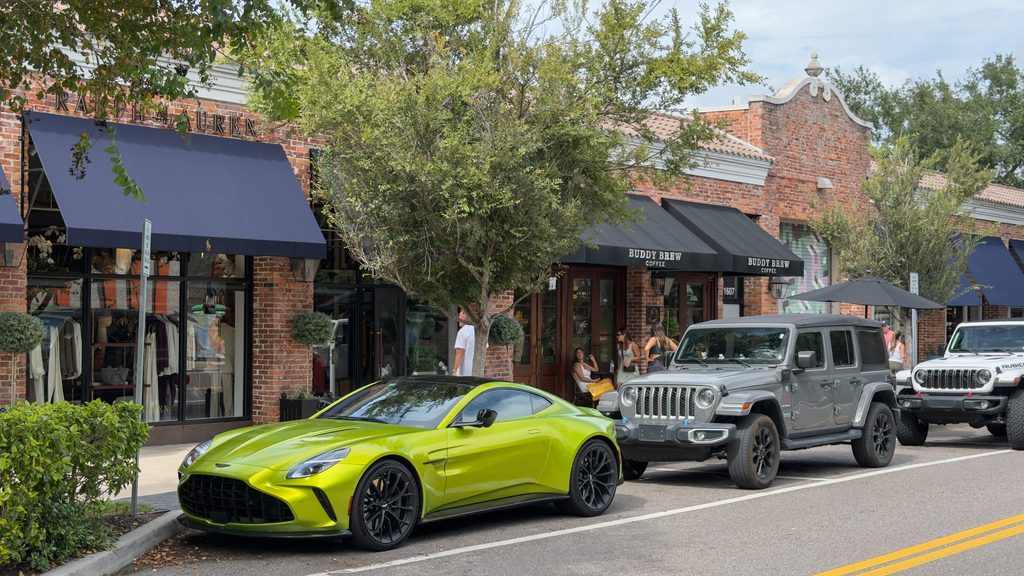
One has coffee shops, storefront awnings, outdoor tables, and a bright green sports car parked at the curb. The other has deep porches, front gardens, and residential streets shaded by enormous oaks.
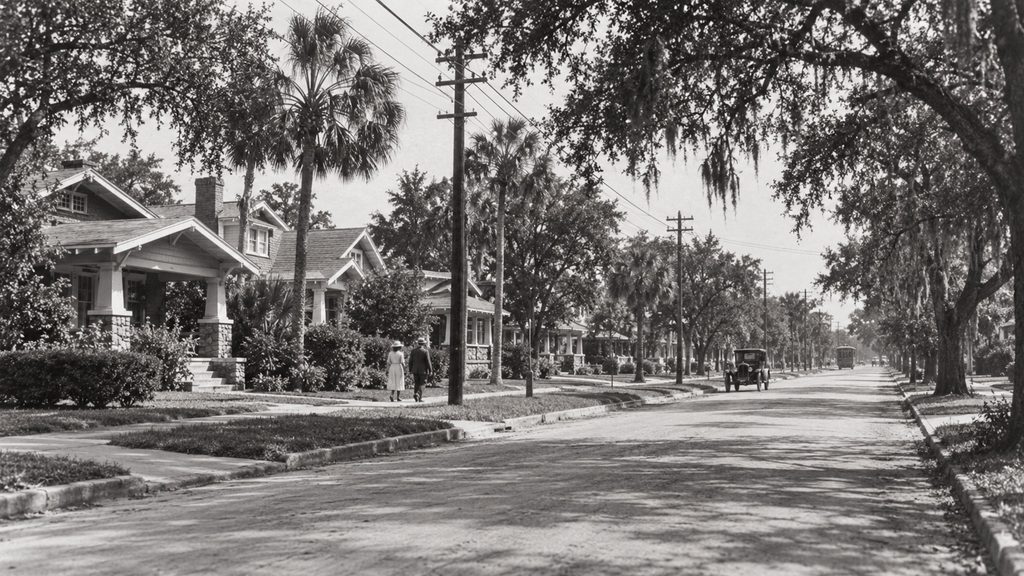
Then there is the old postcard. Utility poles line Hyde Park Avenue. Large houses stand behind their lawns. Overhead wires run through a scene that feels both familiar and surprisingly different.
Put those pictures together and an interesting question emerges: How much of the Hyde Park we recognize today comes from its earliest years, and how much was added later?
Quite a bit of both.
The historic neighborhood and the shopping district called Hyde Park Village have related but different histories. The houses do not all come from the same architectural period. Even the places that feel thoroughly established have continued to change.
That is what makes Hyde Park worth looking at carefully.
My interest in historic homes starts with the buildings, but it rarely stays inside the property lines. A porch makes more sense when you understand the street in front of it. A neighborhood becomes more interesting when you know how people reached it, who lived there, and what happened between its earliest development and the photographs we take today.
For anyone considering buying or selling a home in Hyde Park, that history is useful. It helps explain the neighborhood’s identity and gives us better questions to ask about an individual house.
Before There Was a Hyde Park Village
The story does not begin with shops or a fountain.
Before Hyde Park developed as a residential neighborhood, the area around Spanishtown Creek was associated with an earlier fishing settlement. That community belongs to a history of settlement around the bay that predates the familiar neighborhood names and street grid. Wikipedia
Later accounts trace the Hyde Park name to 1886. According to Hyde Park Village’s published history, O. H. Platt named the area after his hometown of Hyde Park, Illinois. That date concerns the neighborhood’s identity, not the opening of the shopping district visitors know today. Hyde Park
It is an important distinction.
When a place has a successful commercial center, the center can become shorthand for everything around it. Someone says they are going to Hyde Park, and they may mean lunch in the Village, a visit to a particular shop, or a walk through the residential streets.
Those experiences are connected, but they should not be folded into one construction date.
The earlier neighborhood developed as Tampa grew beyond its initial core. Connections across the Hillsborough River helped make the land on the river’s western side part of the city’s expanding residential landscape. Wikipedia
[Image: The early color postcard of Hyde Park Avenue.]
Caption: An early twentieth-century postcard of Hyde Park Avenue, published by Detroit Publishing Co. The houses, utility poles, sidewalks, and open street offer a useful record of how the neighborhood once presented itself.
Look closely at the postcard rather than treating it simply as decoration.
The houses command attention, but so does the infrastructure. There are poles, wires, curbs, and a public right-of-way. This was a neighborhood being occupied and connected, not a collection of isolated country houses.
That practical side of development is easy to overlook when we focus only on architecture.
Henry Plant and the City Across the River
One of the most consequential buildings in this part of Tampa stood north of the residential neighborhood: Henry B. Plant’s Tampa Bay Hotel.
Constructed between 1888 and 1891, the hotel contained 511 rooms. Plant’s railroad and steamship interests connected the hotel to a much larger transportation and tourism enterprise. Its scale expressed an extraordinary level of confidence in Tampa’s future. University of Tampa
The hotel did not create every neighborhood around it, and Hyde Park should not be reduced to a footnote in Plant’s biography. Still, it provides important context for understanding the city that was taking shape.
Consider the contrast. Alongside a developing residential district was an enormous resort designed to receive travelers arriving through Plant’s transportation network. Tampa was building places to live while also presenting itself as a destination.
The former hotel took on another role in 1933 when the University of Tampa occupied the building. Today, the Henry B. Plant Museum preserves part of the hotel’s history through original furnishings, objects, and exhibits within the building. University of Tampa
That is a useful place to begin a deeper exploration of Hyde Park, even though the museum is not a house within its residential streets.
It supplies context. The ambitions, transportation connections, and changing uses of a major neighboring building help explain the world in which those streets developed.
It also introduces a theme that runs through any historic neighborhood: surviving buildings do not always survive by remaining exactly what they were.
A Neighborhood Connected by Streetcars
The automobile is prominent in the contemporary photographs. In the neighborhood’s earlier development, streetcars were also part of the transportation story, including service along Swann and Rome avenues. Wikipedia
That history encourages a different way of looking at the street.
Rather than beginning with the driveway or garage, look at the relationship between the front door, porch, sidewalk, and the next block. Think about how someone would leave the house on foot and reach transportation or a nearby destination.
I would not suggest that every house was designed around an identical routine. A neighborhood contains different households, budgets, and building periods. But transportation is part of the explanation for how a place is arranged.
This is also why an old photograph can be so revealing.
A modern car may obscure the lower portion of a house. New landscaping can hide a foundation. A widened driveway can change the balance between a garden and a walkway. Earlier images sometimes make those relationships easier to see.
The Burgert Brothers Photographic Collection at the Tampa-Hillsborough County Public Library is an excellent resource for that kind of investigation. Its thousands of photographs document residential, commercial, and everyday life in the Tampa Bay region from the late nineteenth century into the twentieth. Hillsborough County Public Library
For someone researching an older property, I would begin with an address, a street name, and nearby landmarks. A useful image may have been cataloged around a neighboring business or an event rather than the house itself.
[Optional image: The black-and-white streetscape created for this article.]
Caption: AI-assisted historical illustration inspired by Hyde Park around 1920. This is not an archival photograph or a verified view of a particular street.
The Houses Are Not All Telling the Same Architectural Story
One of the pleasures of looking through Hyde Park is the variety.
The National Register documentation recognizes architecture from several broad traditions, including Late Victorian buildings, revival styles, and late nineteenth- and early twentieth-century American movements. That is a more accurate starting point than imagining the entire district as one uniform collection of 1920s bungalows. NPGallery
The photographs in this article show some of that variation in scale and form.
There are larger houses with substantial porches. There are lower rooflines and broad front gables. Window arrangements vary. Some entrances are approached through gardens, while others sit more directly in view of the sidewalk.
Those differences are worth preserving in how we describe the neighborhood.
Calling everything a bungalow may be convenient, but it erases distinctions that matter to an owner, a buyer, and anyone trying to understand the building.
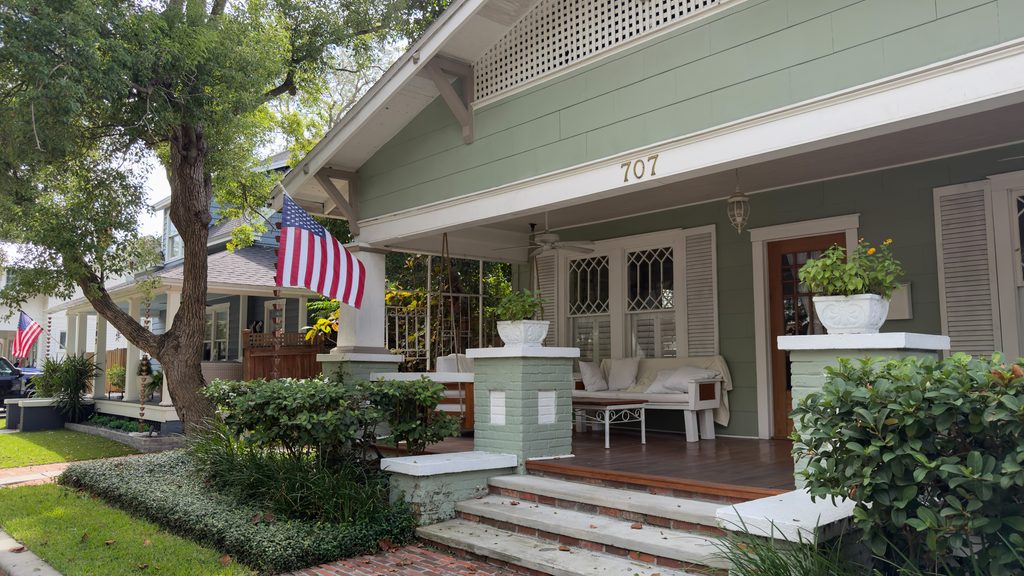
[Image: The green bungalow with the broad porch and house number 707.]
Caption: A broad front gable, substantial porch piers, decorative window patterns, and a shaded sitting area provide plenty to notice in this Hyde Park home. A photograph alone cannot establish the age or originality of individual features.
In the green house pictured here, my attention goes first to the porch.
There is room to sit. The roof provides a definite sense of enclosure without turning the space into an interior room. The steps establish a transition from the garden to the floor above. The windows and entrance give the porch a purpose beyond being an attractive front elevation.
These are details a person can experience, not just photograph.
They also raise good questions. How much of the arrangement is original? Were the windows repaired or replaced? Has the porch ever been enclosed? Are the visible finishes concealing earlier materials?
None of those questions diminishes the appeal of the house. They help us understand it.
Raised floors and the space beneath older houses are another part of the conversation. I explore that subject in Why Don’t Florida Homes Have Basements?, including the distinction between a crawlspace and a full below-ground level.
A beautiful front porch is a good reason to stop and look. It is not a substitute for understanding what supports it.
Dobyville Belongs in the History, Too
A history of Hyde Park that discusses only prominent houses and fashionable destinations would leave out an important community.
Dobyville, a historic Black neighborhood associated with Richard Doby, developed in the western part of the broader Hyde Park area. Its history includes residents working in domestic service and skilled trades, alongside educators, religious leaders, and business owners. Doby donated land for a school, and the community developed institutions of its own. Later transportation projects and redevelopment removed much of its built environment. Wikipedia
That history deserves to be acknowledged alongside the buildings that remain easiest to see.
A surviving house naturally attracts attention because it gives us something tangible to examine. Communities whose buildings have been removed require a different kind of attention, through maps, photographs, records, and the accounts of people who lived there.
For me, this is a reminder not to mistake the surviving landscape for the complete history.
The largest houses were not the whole neighborhood. The buildings photographed most often were not the only places where community life happened.
How Hyde Park Became a Recognized Historic District
Hyde Park’s National Register listing dates to March 4, 1985. The designation recognizes a district whose historical and architectural significance extends across its development in the late nineteenth and early twentieth centuries. NPGallery
That recognition is important, but it is only one part of the preservation story.
Tampa also has a locally regulated Hyde Park historic district. Its boundaries expanded effective January 5, 2023, bringing 184 additional buildings into the local district. The city’s Hyde Park district expansion page explains that change and connects readers to the relevant resources. City of Tampa
For an owner or prospective buyer, the distinction between national recognition and local regulation matters.
National Register listing by itself does not impose the same restrictions on a privately owned property as a local preservation ordinance. Local requirements may apply independently, and projects involving federal assistance or approvals can raise additional considerations. National Park Service
In practical terms, “It’s in Hyde Park” is not a complete answer to a renovation question.
The address, the applicable district, the property’s classification, and the proposed work all need to be understood. Tampa’s historic district maps are a useful starting point, but the city specifically cautions that the maps alone do not establish whether a building is contributing or noncontributing. City of Tampa
I would rather help a buyer ask those questions before making a commitment than have them discover a restriction while preparing to order windows or submit plans.
Hyde Park Village Is a Later Chapter
The residential neighborhood is much older than the modern retail development.
Hyde Park Village opened in 1985, initially with a department-store and movie-theater component among its attractions. It was a later commercial project within an already established part of Tampa, not an intact shopping district carried forward unchanged from the neighborhood’s earliest years. Wikipedia
Even the fountain provides a useful date.
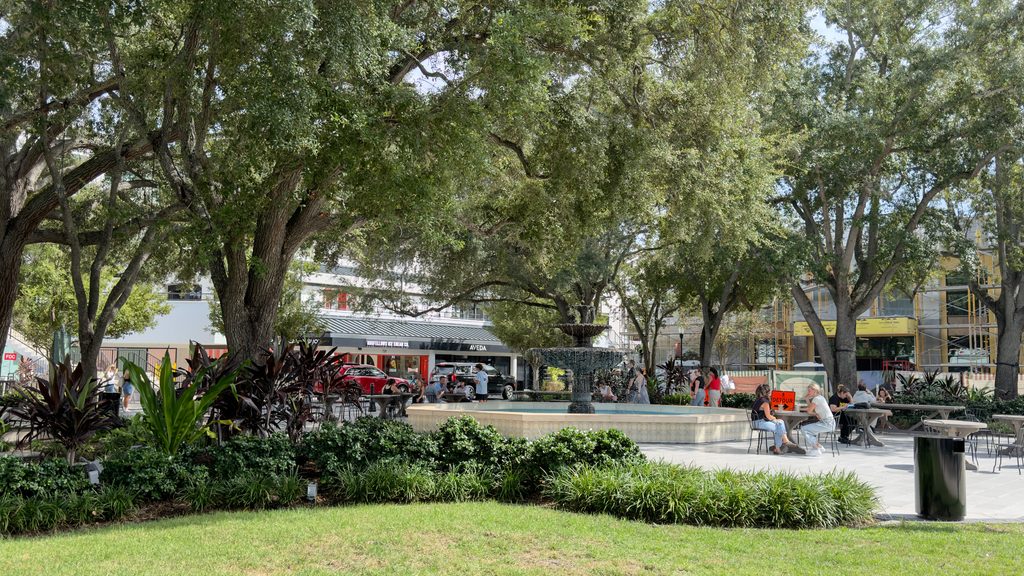
According to the Village’s own history, the Village Circle fountain was built in 1983. It has had decades to become familiar, but it is not a surviving feature from 1920. Hyde Park
[Image: The Village fountain and surrounding seating area.]
Caption: The fountain and public gathering area belong to the Village’s later development. Shade, seating, and surrounding businesses make the space feel established, while the construction visible in this photograph is a reminder that it continues to change.
I find that distinction interesting rather than disappointing.
A place does not have to be as old as its oldest neighboring house to matter. Familiarity accumulates. People meet for coffee, bring visitors, attend events, and return to the same places over many years.
The mistake would be to confuse an established contemporary setting with an untouched historic one.
The Village’s more recent transformation includes its acquisition by WS Development in 2013, revitalization work between 2015 and 2018, and completion of the Snow Avenue building in 2019. These changes form another layer in its history. Hyde Park
Today, Hyde Park Village describes itself as a six-block shopping and dining destination combining local businesses and national brands. Its official website is the best place to check the current directory and events rather than relying on an older article’s tenant list. Hyde Park
[Image: The brick storefronts, Ralph Lauren and Buddy Brew awnings, and green sports car.]
Caption: Contemporary businesses and vehicles place this Village scene firmly in the present. The brickwork, awnings, and pedestrian frontage provide a visual connection with the surrounding neighborhood without making every building an early twentieth-century original.
That photograph is a useful companion to the old postcard.
Not because it shows the same block or the same viewpoint. It does not establish a direct before-and-after comparison. It shows how different periods can contribute to the identity of a place.
What the Streets Reveal Between the Destinations
It would be easy to write about Hyde Park as a list of places to visit. The quieter residential photographs suggest another approach.
Look at the space between the curb and the houses.
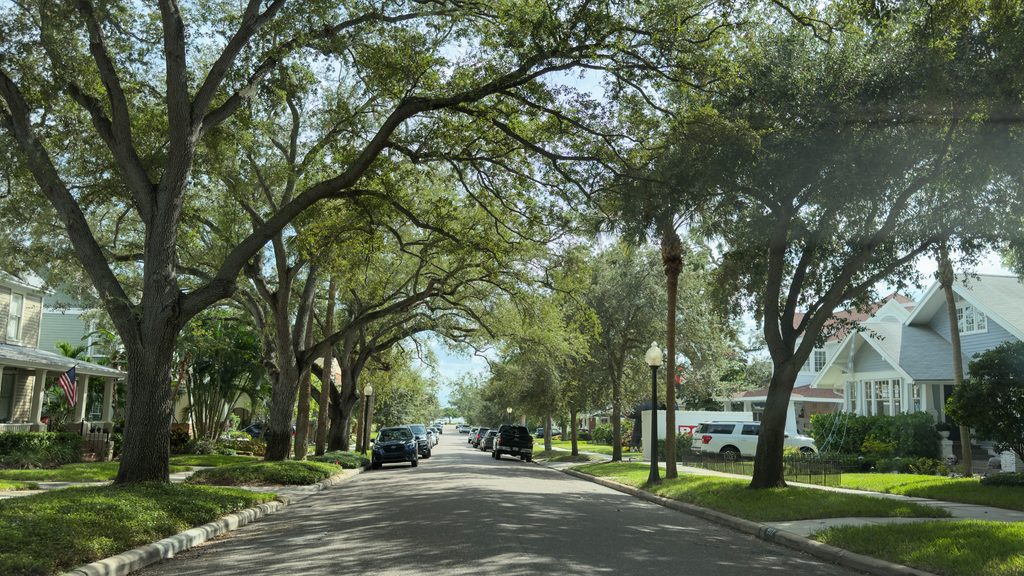
There are sidewalks, planting strips, lawns, gardens, and paths to front doors. The trees have a tremendous presence. Porches create an intermediate space where a person can be at home without being entirely removed from the street.
Those are some of the details I would encourage a buyer to notice.
A house is experienced from the inside, but its setting becomes part of daily life. You see the neighboring roofline through a window. You approach the front door after parking. You hear what happens on the street and decide where you would sit outside.
The photographs show an appealing setting. They cannot tell you how a particular block functions at every hour.
That requires time on the ground.
I would encourage someone considering a home here to return at different times, walk the surrounding public streets, and think about their actual routine. Where would guests park? Which entrance would they use most? Would the porch become a favorite sitting area, or does the household prefer privacy in the rear garden?
These are ordinary questions, but they are often more useful than another adjective in a listing description.
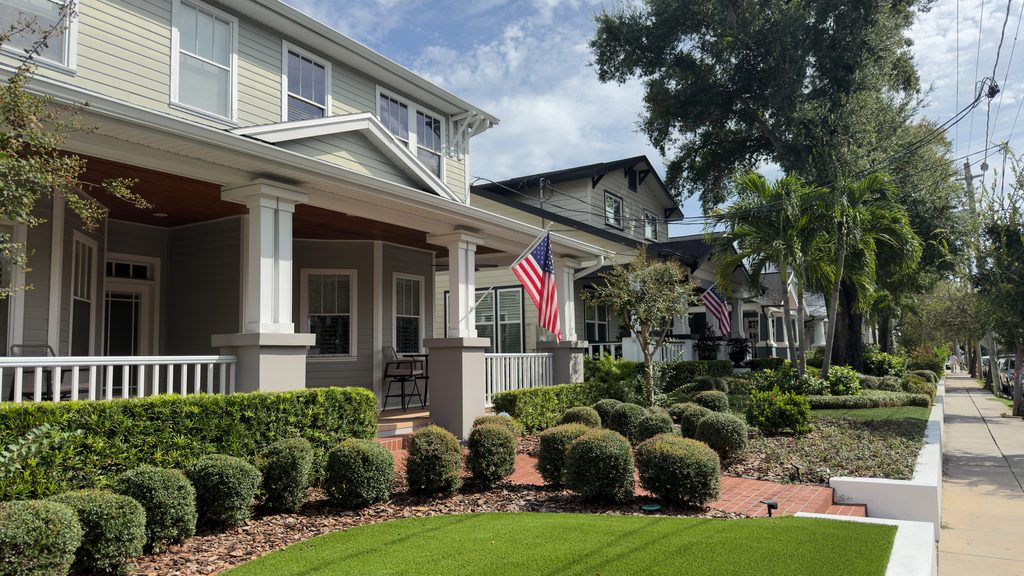
[Image: The row of front porches, flags, gardens, and brick walkways.]
Caption: The relationship between the house, garden, and sidewalk is part of the experience of owning a home here. Architectural appearance alone does not establish a building’s construction date or historic status.
Buying a Historic Home in Hyde Park: Admiration Is the Beginning
The appeal of an older home can be immediate. Understanding the property takes longer.
My first priority would be to establish what is actually being purchased, not simply what the house resembles.
That means looking for records of construction, additions, permits, and significant alterations. A beautifully finished room may be an original part of the house, a later addition, or a converted porch. Those distinctions can affect the questions we need to ask.
I would also want the buyer to separate the condition of the finishes from the condition of the building.
Fresh paint and an attractive kitchen are easy to see. The structure, roof, wiring, plumbing, drainage, and any accessible space beneath the floor require a different kind of review. The appropriate inspectors and specialists should evaluate the property rather than allowing appearance to settle those questions.
The intended renovation matters just as much as the existing condition.
A buyer who wants to enjoy the house substantially as it stands may have different concerns from someone planning an addition or major exterior changes. Tampa’s Historic Preservation office reviews applicable work, and certain projects require a Certificate of Appropriateness. The city’s Hyde Park Design Guidelines are part of that planning process. City of Tampa
I would also want insurance questions addressed early, using the actual property rather than assumptions based on a neighboring home. Flood information, elevation, known water intrusion, prior improvements, and proposed work belong in that property-specific discussion with the relevant professionals.
Then comes the less technical question: Does this house suit the way you live?
An older floor plan may be exactly what attracts one buyer and an inconvenience to another. Storage, room connections, laundry placement, parking, stairs, and outdoor space all deserve an honest look.
The goal is not to discourage someone from buying a historic home. It is to help them make a decision they will still feel good about after the excitement of the first showing.
My guide to buying and selling historic and older homes in Tampa Bay explores more of the questions that belong in that process.
Selling a Home in Hyde Park Requires More Than Calling It Historic
For a seller, the challenge is different.
You may know the house intimately. You know how the light reaches a particular room, why you restored a window instead of replacing it, or which part of the porch is most comfortable in the afternoon.
A buyer does not arrive with that knowledge.
My role as a listing agent is to identify what matters, verify what can be verified, and communicate it in a way that helps buyers understand the property.
I would begin with the house’s records and the owner’s experience. Construction information, renovation documentation, plans, permits, maintenance history, and older photographs can all help build a more reliable picture.
I would be careful with words such as “original,” “restored,” and “historic.”
A decorative feature should not be called original simply because it looks old. An attractive renovation should not be described as a historical restoration unless that description is accurate. Precision makes the marketing stronger.
Photography should support that same standard.
I want the overall rooms and exterior, but I also want the details that explain the house: the porch, the relationship to the street, a documented architectural feature, or a view that helps someone understand the setting. A tightly cropped photograph can be beautiful while telling a buyer very little about how the property functions.
The neighborhood belongs in the presentation, too, provided it is represented accurately. A buyer considering Hyde Park is evaluating both a home and its location. The connection between those two should be clear without suggesting that every address offers an identical experience.
Pricing requires a separate discipline.
History can make a property interesting. It does not, by itself, establish the price someone will pay. I would evaluate relevant comparable properties, condition, location, usable space, improvements, and the alternatives a buyer is likely to consider.
The story and the market analysis need to work together.
For an owner preparing to sell, my seller’s guide provides a starting point for the process. A property-specific valuation conversation is the next step when the question becomes what your particular home may be worth in the market.
How to Research the History of Your Own Hyde Park Home
One of the most satisfying parts of owning an older house is discovering something about it that was not included in the listing.
I would start with the address and work outward.
Gather the documents already connected with the property. Ask previous owners about older photographs, plans, and the timing of changes. Compare those materials with public property and permit records, then look for the house in historical maps and photographic collections.
Do not assume a repeated story has been verified simply because several people have repeated it.
A construction date in one record may need clarification. A photograph may show an earlier configuration rather than the original building. An account of a previous owner might be a promising research lead without yet being a documented fact.
The Burgert Brothers collection can be useful here, as can the city’s preservation resources. When using an archival image in a publication, follow the archive’s credit and usage requirements. The library specifies a credit to the Tampa-Hillsborough County Public Library System for reproductions from its collection. Hillsborough County Public Library
Keep a record of what you find and where it came from.
That file can become valuable to the next owner. It also prevents a future researcher from having to start over with the same uncertain information.
A Few Common Questions About Hyde Park
Is Hyde Park Village the same thing as the historic neighborhood?
No. Hyde Park Village is a shopping and dining district within the broader Hyde Park area. The neighborhood’s development predates the modern retail project, which opened in 1985. Hyde Park
Is every house in Hyde Park an original historic home?
No assumption should be made from the neighborhood name or appearance alone. A property’s age, alterations, designation, and contributing status need to be checked individually. The city advises that its district maps alone do not establish contributing or noncontributing status. City of Tampa
Can you renovate a home in the historic district?
Renovation is possible, but the requirements depend on the property and the work. Applicable exterior projects may require preservation review and a Certificate of Appropriateness. The city should be consulted before committing to plans or materials. City of Tampa
Why Hyde Park Is Worth Understanding
What holds these photographs together is not a single building style or a single moment in time.
It is the relationship between the homes, the streets, and the places people use.
The postcard records an earlier neighborhood with its own infrastructure and ambitions. The contemporary residential pictures show houses being maintained, adapted, and lived in. The Village photographs show a commercial center that has become familiar while continuing to evolve.
I think all three are necessary to understand Hyde Park honestly.
There is no need to pretend every detail is original, or that change began only recently. The history is interesting enough without making it tidier than it was.
As a Realtor, I want buyers to understand what draws them to a house and what responsibilities come with owning it. I want sellers to have the distinctive qualities of their property represented clearly, without exaggeration.
That is where local history becomes practical.
It gives us a better description of the place, a better set of questions, and a stronger foundation for the decisions that follow.
Buying or Selling a Home in Hyde Park, Tampa?
I’m Mark Middleton, a Tampa Bay REALTOR® with Middleton Tampa Bay at Compass. My work focuses on historic, waterfront, and distinctive homes, including helping buyers and sellers understand the properties and neighborhoods that make Tampa Bay different.
For a Hyde Park buyer, that means looking beyond the first impression and evaluating the house, its condition, its setting, and the questions that deserve further investigation. For a seller, it means thoughtful preparation, property-specific pricing, accurate storytelling, and photography that helps people understand what they are being offered.
My interest in architecture and local history also runs through my photography at Mark A. Middleton and the community stories at Discover Delightful Dunedin. Readers who enjoy exploring how Tampa Bay’s communities developed may also appreciate my history of Safety Harbor.
Considering a historic home in Hyde Park, or preparing to sell one? Call or text me at (727) 871-7653, email MarkMiddleton@Compass.com, or contact me here.
I would enjoy hearing about the house, what matters to you, and what you are planning next.