
How Clearwater’s first planned residential neighborhood became one of Tampa Bay’s most remarkable collections of historic homes
By Mark Middleton
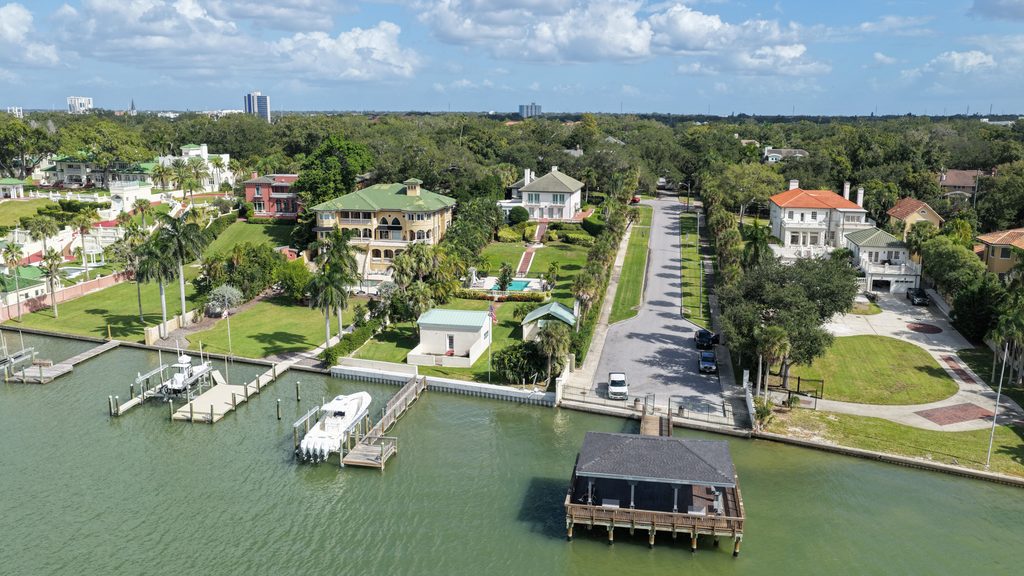
There are neighborhoods where the individual houses command all of your attention, and there are others where the streets themselves tell you that someone had a larger idea in mind. Harbor Oaks belongs in the second category.
I spent time walking and photographing the neighborhood recently because I wanted to understand it beyond the individual homes I had seen over the years. I knew Harbor Oaks was historic. I knew it contained some extraordinary residences. What became much clearer after walking the streets, standing at the Magnolia Drive dock, and later seeing the neighborhood from above was how deliberately the entire place was conceived.
Harbor Oaks was not simply a collection of expensive houses that happened to appear near the water. It was Clearwater’s first planned residential development, opened in 1914 by New York developer Dean Alvord. At a time when much of Florida was still developing without formal zoning or the infrastructure we now take for granted, Harbor Oaks offered paved streets, curbs, sidewalks, underground utilities, a sewer system, tree-lined parkways, and deed restrictions intended to protect the residential character of the neighborhood. Contemporary advertisements were not subtle about the ambition. Harbor Oaks was promoted as “the Riviera of the Sunny South” and “the finest shore development on the West coast of Florida.”
More than a century later, the promotional language feels extravagant, but the original idea is still visible.
That is what makes Harbor Oaks so interesting to me. You are not looking only at old houses. You are looking at one of the earliest attempts in this part of Florida to think carefully about how an entire residential neighborhood should look, function, and age.
A Neighborhood Planned Before Clearwater Had Fully Grown Around It
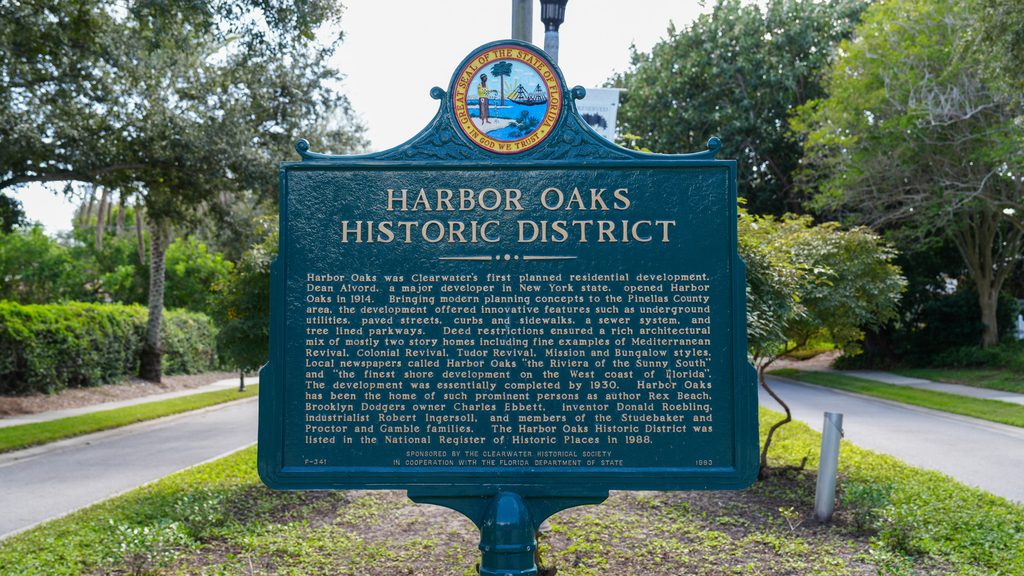
The history begins with Dean Alvord, an experienced real estate developer from New York who had worked on large residential projects before turning his attention to Florida. Harbor Oaks opened by January 1914, and the earliest homes were concentrated around Druid Road, Jasmine Way, and Magnolia Drive. The first group of houses was completed by 1915, and development continued gradually before accelerating during Florida’s great real estate boom of the 1920s.
What Alvord was selling was more than land.
The National Register nomination for Harbor Oaks describes a development with unusually modern infrastructure and land-use controls for the period. Deed restrictions governed permitted uses, setbacks, and even the cost of houses being built. In an era before municipal zoning had become a normal part of American development, those private restrictions were intended to prevent incompatible commercial construction and preserve the value and appearance of the neighborhood.
There is a real estate lesson hidden inside that history.
More than one hundred years ago, buyers were already paying for more than the house. They were paying for confidence in what the surrounding neighborhood might become.
We still do exactly that today.
You Can See the Planning in the Street
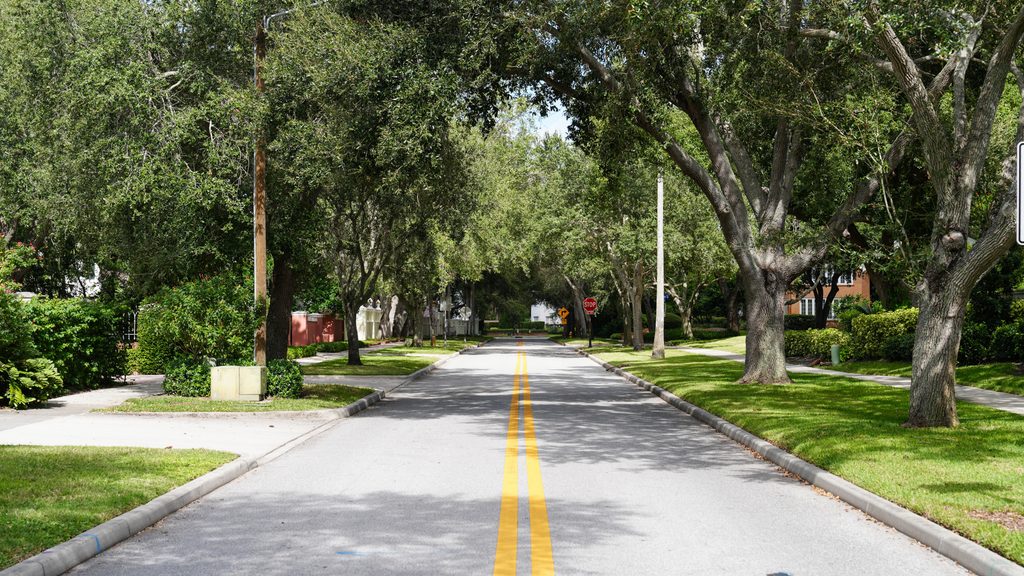
One of the most useful documents I found while researching Harbor Oaks is its National Register nomination. It describes the streetscape as a significant part of the neighborhood’s character, noting the broad streets, wide parkways, sidewalks, esplanade along Bay Avenue, and rows of palms and oaks planted during the neighborhood’s early years. It even calls attention to the original-style street lighting and massive entrance pillars that helped define Harbor Oaks as a distinct place.
Walking it, you understand what the document means.
The houses have room around them. The setbacks are generally consistent. Mature vegetation gives the streets an enclosure that newer developments spend decades trying to achieve. Sidewalks remain separated from the road by grass and trees in many places, and the homes relate to one another without feeling crowded together.
This is an important point when evaluating historic neighborhoods. The value is not contained entirely within the walls of an individual house. Lot dimensions, setbacks, tree canopy, street width, sidewalks and neighboring architecture all contribute to what someone experiences when they arrive home.
A beautiful house can be built almost anywhere.
Recreating a mature neighborhood is much harder.
The Architecture Was Never Supposed to Be Uniform
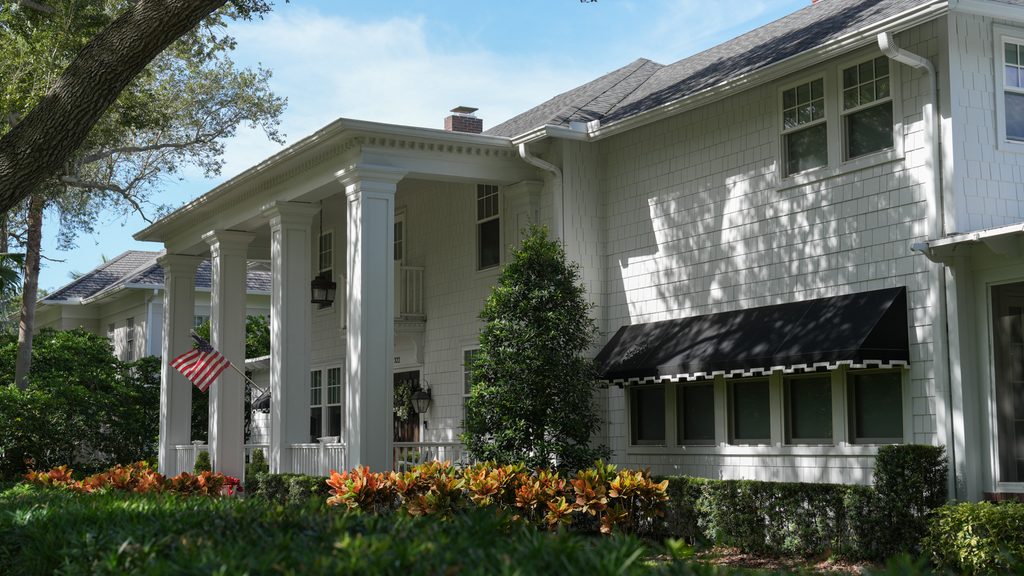
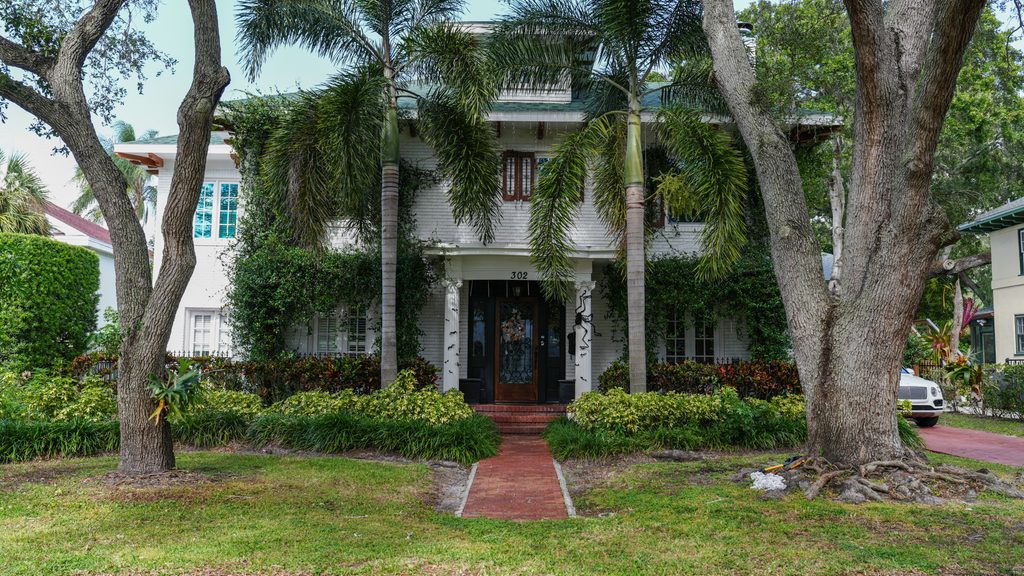
One of the pleasures of photographing Harbor Oaks is realizing how much architectural variety exists within a relatively compact area.
The Florida historical marker identifies Mediterranean Revival, Colonial Revival, Tudor Revival, Mission, and bungalow architecture among the neighborhood’s significant styles. National Register research identifies Colonial Revival as the dominant influence while also documenting Prairie School characteristics, bungalows, revival architecture, and other early twentieth-century forms.
That variety is important because it prevents Harbor Oaks from feeling like a planned neighborhood in the modern sense of repeating the same elevation every third house.
The planning created order without requiring sameness.
Many houses are two stories, and the National Register nomination notes recurring characteristics such as broad eaves, formal central entrances, substantial lots, and carefully controlled setbacks. Materials range from wood clapboard to stucco, brick veneer, and hollow clay tile. Colonial Revival houses from roughly 1915 through the mid-1920s often have balanced facades and classical details, while the neighborhood’s bungalows use lower forms, broad eaves, porches, grouped windows, and substantial brackets.
Those details are precisely why I prefer walking a historic neighborhood to simply scrolling through listing photographs.
Architecture makes more sense when you see one house beside another.
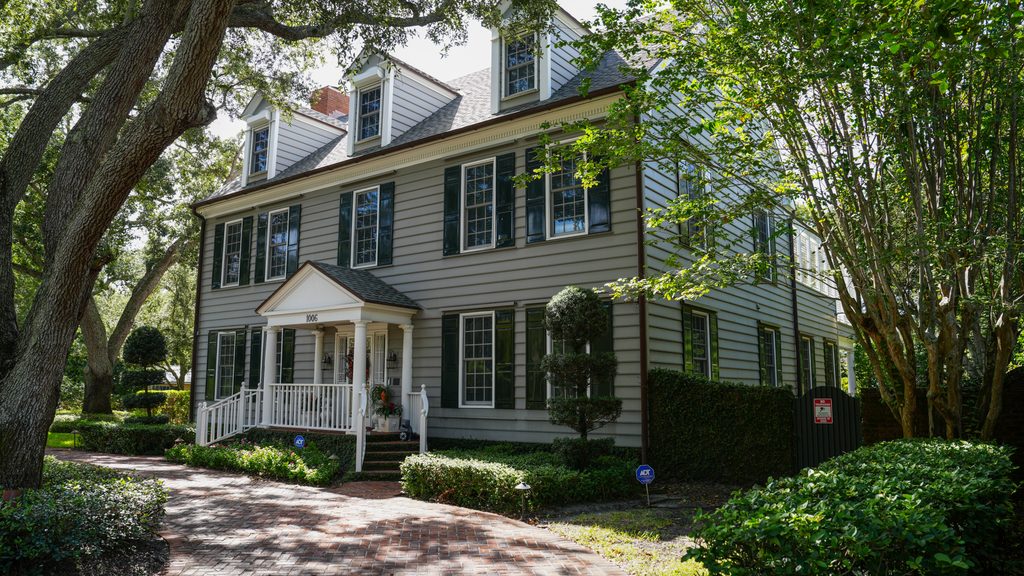
The Houses Tell Different Stories
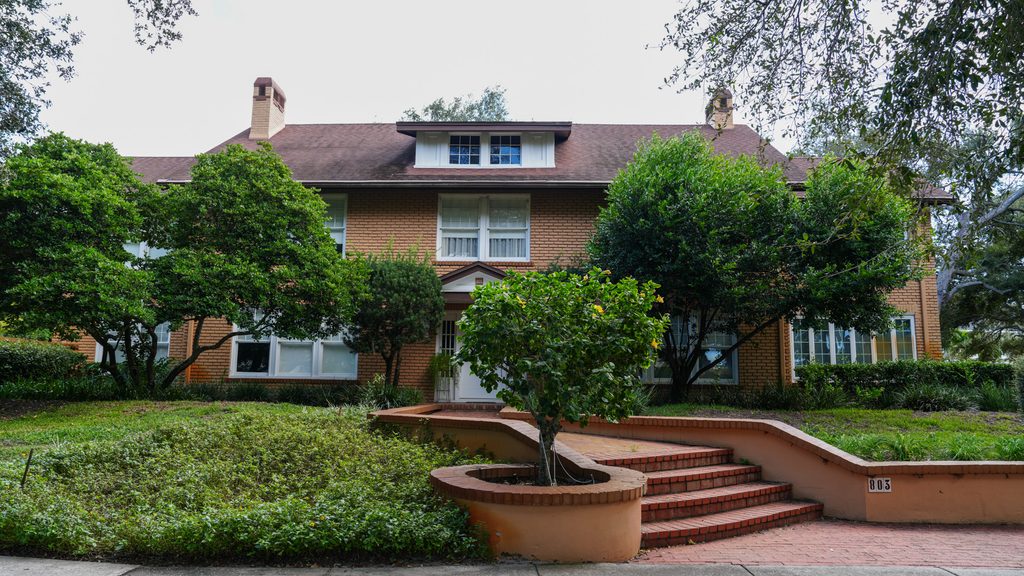
The brick house pictured here immediately feels different from the more formal white residence nearby. Its dormers, arched brick openings, restrained entrance and relationship to the landscaping create a different architectural experience, yet it still belongs comfortably on the same streets.
That is one of Harbor Oaks’ strengths.
A neighborhood with genuine architectural depth rewards looking carefully. You begin noticing windows rather than merely counting them. Roof pitch starts to matter. You recognize how an entrance is framed, whether a porch functions as an outdoor room or simply a decorative element, and how houses use brick, wood or stucco differently.
For someone considering buying an older home, those observations also lead to practical questions. Are the windows original? Has the house been expanded? Were porches enclosed? Is an addition compatible with the original structure? What are the underlying construction materials? Which renovations occurred recently, and which may date back decades?
Historic character and physical condition are not the same thing.
A house can be architecturally wonderful and still require significant work.
The Waterfront Changes Everything
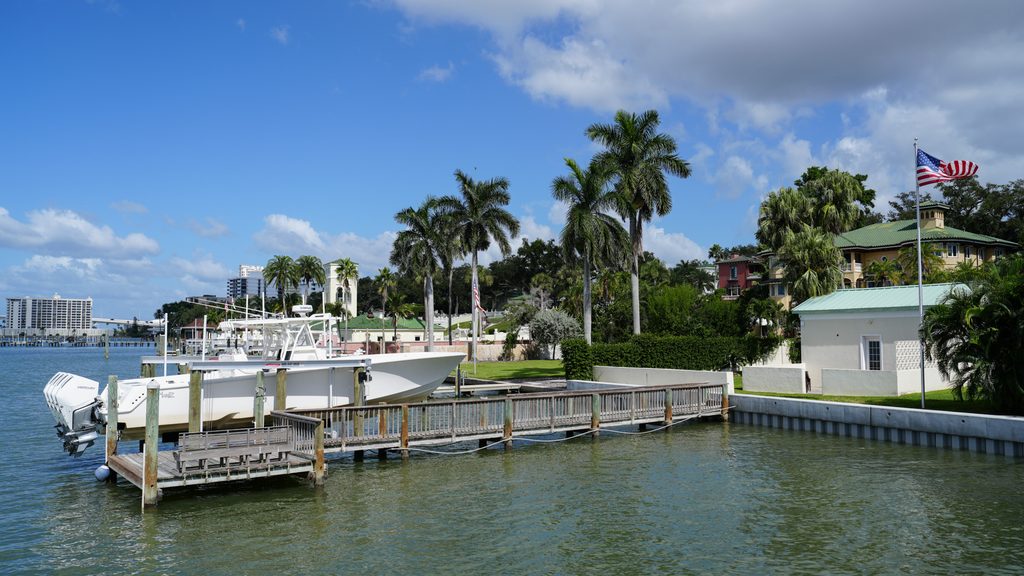
Then there is the water.
Harbor Oaks sits along Clearwater Harbor on a bluff above the bay, and its waterfront parcels were among the neighborhood’s most ambitious lots. National Register documentation describes many original interior lots as approximately 60 by 130 feet, while the parcels along the water could extend hundreds of feet from the street toward Clearwater Harbor.
From the air, the difference is obvious.
Some of the waterfront properties function less like conventional city lots and more like estates. There is room for lawns, pools, gardens, secondary structures, docks, and long views toward the water.
This is where Harbor Oaks becomes more than a historic-home neighborhood.
It is also part of Clearwater’s luxury waterfront market.
Those two identities overlap, but buyers should understand that each introduces its own set of questions. An older waterfront estate requires a different level of due diligence from an inland bungalow. Historic construction, seawalls, docks, drainage, elevation, flood exposure, insurance, additions, mechanical systems and previous renovations may all need to be examined separately.
The view may be extraordinary.
It should never be the only thing you investigate.
Magnolia Drive Dock and the Neighborhood Around It
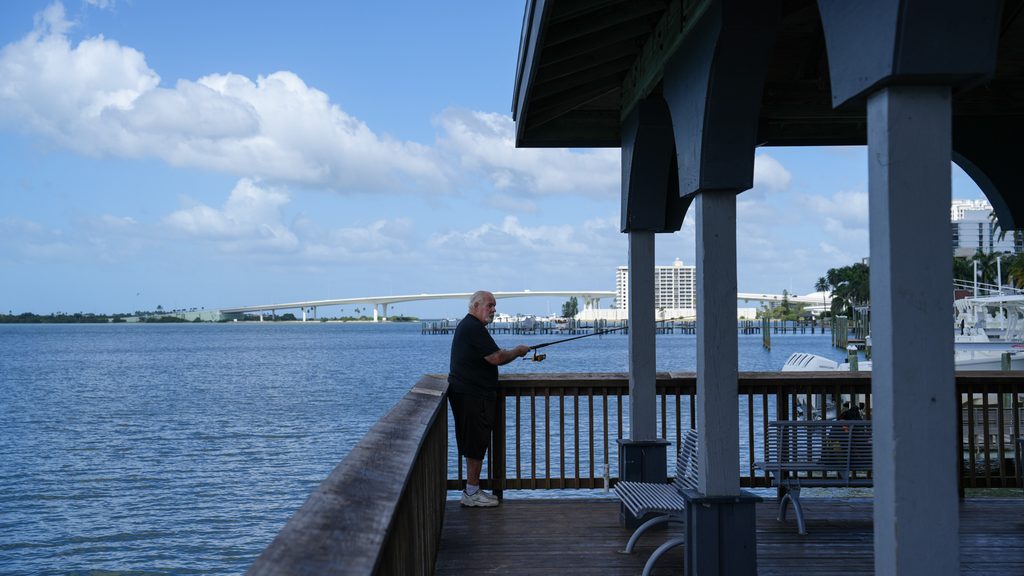
One of my favorite stops during this walk was Magnolia Drive Dock.
It is easy to treat a dock simply as access to the water, but this one has a neighborhood history of its own.
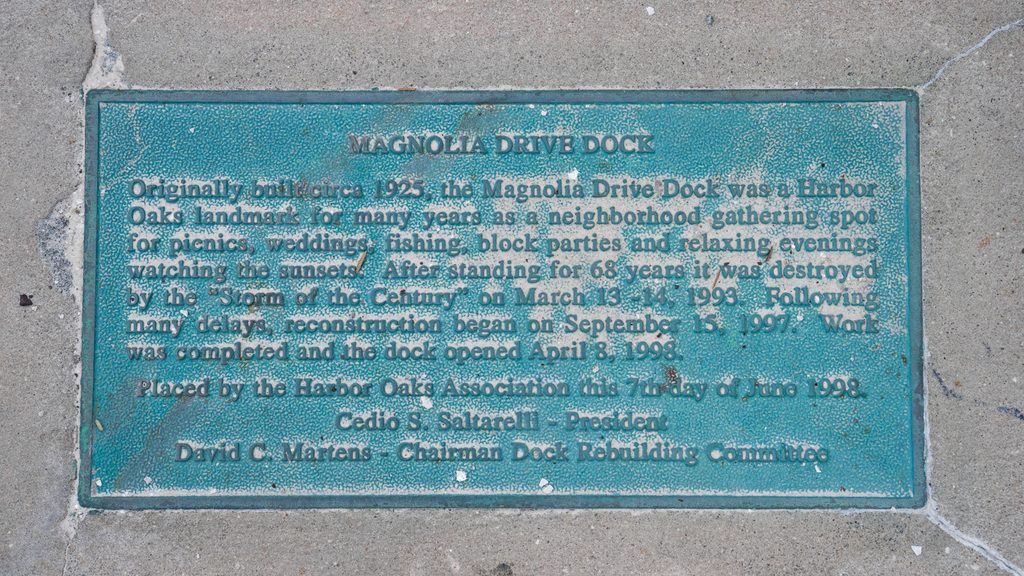
The original Magnolia Drive Dock was built around 1925 and became a gathering place for picnics, weddings, fishing, block parties and evenings spent watching the sunset. It survived for 68 years before being destroyed during the March 1993 “Storm of the Century.” Reconstruction finally began in 1997, and the replacement dock opened in April 1998.
What I like about that story is how ordinary the uses were.
People got married there. They fished. They had neighborhood parties. They watched the sun go down.
Architecture usually receives most of the attention in a historic district, but places become meaningful because of how people use them. A dock can become every bit as much a neighborhood landmark as a mansion.
Standing there today with someone fishing at the railing and Clearwater Harbor stretching out beyond him, that continuity is easy to understand.
Before Harbor Oaks, There Was Fort Harrison
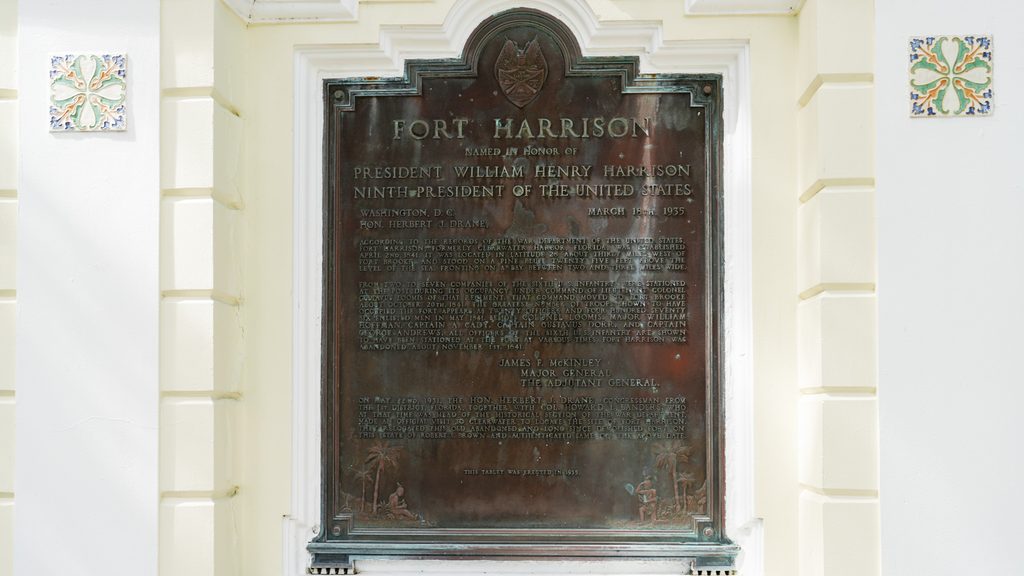
Harbor Oaks also sits within a much older Clearwater story.
A historical marker in the area commemorates Fort Harrison, a short-lived military post established in 1841 during the Second Seminole War. According to the War Department information recorded on the marker, the fort was located on a pine bluff above the water and was occupied by troops of the Sixth U.S. Infantry before being abandoned later that same year. The site was investigated and authenticated in the early 1930s, and the tablet was erected in 1935.
The fort itself disappeared long before Harbor Oaks was developed, but I think its presence is an important reminder of how many histories can occupy the same land.
A waterfront estate may appear to define a site today.
It rarely tells the entire story.
Prominent Residents Came Here for a Reason
Harbor Oaks eventually attracted a remarkable collection of nationally prominent residents.
The neighborhood’s official historical marker lists author Rex Beach, Brooklyn Dodgers owner Charles Ebbets, inventor Donald Roebling, industrialist Robert Ingersoll, and members of the Studebaker and Procter & Gamble families among those who lived there.
Some arrived during Florida’s boom years, when Clearwater was increasingly attracting wealthy winter residents from the North.
The National Register research identifies writer Sewell Ford as one of the first nationally known figures to establish a winter home in Harbor Oaks. His house on Druid Road, which he called Casa de San Antonio, was among the neighborhood’s early residences. Others followed as the development matured.
I would be careful, however, about reducing Harbor Oaks to a list of famous names.
The more important point is what those residents tell us about Clearwater at the time.
This was a small Florida city successfully attracting people with substantial resources who could have established winter homes in many places. Harbor Oaks was being positioned as an answer to Palm Beach, St. Petersburg, Sarasota and other emerging Florida destinations.
The neighborhood itself was part of the sales pitch.
The Landscape Is Architecture Too
One of the strongest things Harbor Oaks has today could not have been purchased fully grown in 1914.
The trees.
Walking beneath mature oaks and palms changes the scale of the neighborhood. Houses that might feel imposing on an empty lot become partially concealed. Sunlight is broken into patches. Sidewalks feel cooler. Views unfold gradually rather than presenting the entire house at once.
The National Register documentation specifically notes that many of the palms and oaks lining the streets dated back to the earliest years of development.
That matters for preservation because a historic neighborhood is more than a collection of structures.
Remove enough mature trees, widen enough driveways, eliminate enough original setbacks and replace enough landscaping with hardscape, and the architecture may remain while the neighborhood itself begins feeling different.
Preservation is often about protecting relationships rather than individual objects.
National Register Does Not Mean What Many Buyers Think It Means
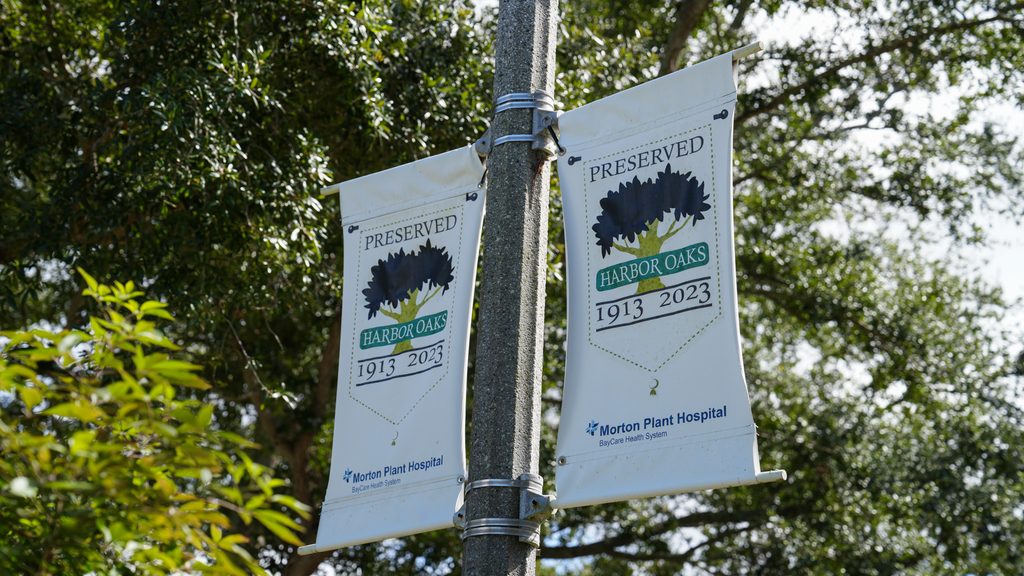
Harbor Oaks was listed in the National Register of Historic Places in 1988. The federal nomination recognizes its significance in architecture, community planning, development and social history.
This is also where buyers and sellers should slow down.
A National Register listing is not automatically the same thing as a locally regulated historic district.
Clearwater’s current Comprehensive Plan specifically describes Harbor Oaks as the city’s only National Register historic district and discusses working with property owners to determine whether there is interest in pursuing local historic district designation. That distinction matters.
In other words, do not hear “historic district” and assume you already understand what can or cannot be changed on a particular house.
The property itself, any applicable local rules, deed restrictions, permits and proposed work all need to be investigated individually.
This is the same advice I give when discussing older homes throughout Tampa Bay on Historic Homes Tampa Bay. Historic status, architectural age, deed restrictions and municipal preservation requirements are related concepts, but they are not interchangeable.
Buying a Historic Home in Harbor Oaks
If I were helping someone buy in Harbor Oaks, I would begin with the same thing that attracted me while photographing it: the house.
Then I would work outward.
What year was it built? Which architectural period does it belong to? How much appears original? What additions have been made? Are there historic windows? Has the roof form changed? What has happened to the porch? What electrical and plumbing systems exist today? Is the foundation accessible? Are there crawlspaces? How has moisture been managed? What renovations were permitted?
Then I would look at the property around the house.
If it is waterfront, what is the condition of the seawall? Is there a dock? What does the elevation information show? What flood zone applies? What insurance information is available? Are there mature trees that may require arborist attention? Is there an accessory structure, and what is its history?
These are not reasons to avoid an older home.
They are reasons to understand one.
Some buyers are ideally suited to historic properties because they appreciate what cannot be recreated. Others discover that they really want historic appearance with newer construction behind it.
Neither preference is wrong.
My job is to help determine the difference before someone makes a very expensive assumption.
Selling a Harbor Oaks Home Is a Different Marketing Assignment
The seller’s challenge is almost the reverse.
A homeowner may have decades of knowledge about the property that a buyer cannot see during a forty-minute showing.
Perhaps the windows were restored instead of replaced. Maybe the original plans survive. There may be photographs showing an earlier configuration of the house. A significant architect or former resident may be documented. The kitchen renovation might be obvious, while a far more expensive structural improvement is nearly invisible.
That information deserves to be organized.
Selling a historic or distinctive property is not simply a matter of taking attractive photographs and putting the house into the MLS. The marketing needs to identify which aspects of the property are genuinely special, document them accurately, and explain them without exaggeration.
Harbor Oaks makes that especially important because buyers are not merely comparing square footage.
They may be comparing architecture, restoration quality, waterfront, lot size, historical character, mechanical updates, street position, and renovation risk.
Those are far more nuanced comparisons.
My real estate work through Middleton Tampa Bay at Compass focuses heavily on historic, waterfront, luxury and distinctive properties throughout Clearwater and the greater Tampa Bay area. For me, the interesting part of representing a property like this is figuring out what story is actually true and then making sure the market sees it.
Pricing Harbor Oaks Requires Restraint
Harbor Oaks is also a good example of why neighborhood-wide statistics can become misleading.
It is a small market with relatively few transactions. A single large waterfront estate can move a median dramatically. Current public market data illustrates the problem. Redfin recently reported a Harbor Oaks median based on extremely limited sales volume, with only one home included in its displayed period. That number may be interesting, but it should not be treated as a reliable valuation shortcut for the next property.
This is exactly the sort of neighborhood where comparable selection matters more than a headline statistic.
An interior historic home and a deep-water estate may share the same neighborhood name while belonging to entirely different competitive sets.
Condition can also overwhelm simple price-per-square-foot comparisons.
A thoroughly restored historic residence with updated systems can command a different audience from a house of similar age requiring substantial rehabilitation. Waterfront, lot size and architectural importance can create further differences.
Pricing requires knowing what a real buyer is likely to compare.
Not simply what happened to sell nearby.
Harbor Oaks and the Larger Clearwater Story
Harbor Oaks fills an important gap in how Clearwater is usually presented.
Ask someone from outside Tampa Bay about Clearwater and there is a good chance the first thing they picture is Clearwater Beach.
That is understandable.
But Clearwater is much older and more layered than its beach identity suggests.
Harbor Oaks shows another side of the city, one connected to early twentieth-century planning, substantial residential architecture, winter residents, Clearwater Harbor, Fort Harrison and the development of the mainland community.
It also sits near another part of Clearwater history that has changed dramatically. The National Register nomination written in the 1980s described the Belleview Biltmore Hotel to the south as an important neighboring landmark. Much of that famous resort was later demolished, although portions of its history survive through preservation and redevelopment.
That contrast makes Harbor Oaks more interesting to me.
Historic places do not survive automatically.
Someone decides they are worth maintaining.
Then someone else makes the same decision years later.
Why I Wanted to Photograph Harbor Oaks Now
I have spent much of the last year thinking about how to make Historic Homes Tampa Bay more useful.
I do not want it to become a collection of generic articles about old houses.
There is enough of that on the internet already.
What interests me is documenting the actual neighborhoods, architecture, streets and houses that make Tampa Bay distinct. That means going there myself, walking the streets, taking photographs, reading the historical records, and understanding how the history connects with what a buyer or seller encounters today.
Harbor Oaks is exactly the kind of place that deserves that treatment.
The drone photographs show the scale and relationship to Clearwater Harbor. The street photographs show what mature planning looks like after a century. The individual homes reveal architectural differences that would be lost in a neighborhood overview. The dock tells a story of people gathering around the water. The historical markers remind us that even a carefully planned 1914 development sits on land with a much older history.
None of those things requires pretending the neighborhood has been frozen in time.
It has changed.
That is part of the story too.
Walk It Before You Decide What You Think
This may be the simplest recommendation in the entire article.
If you are interested in Harbor Oaks, walk it.
Do not only drive through.
The neighborhood reveals itself at the speed of a person on foot.
You notice the width of the parkways. You see how far the houses sit from the sidewalk. You begin identifying architectural differences. You notice the old entrance pillars, street trees and glimpses of Clearwater Harbor between homes.
Walk toward Magnolia Drive and stand at the dock for a few minutes.
Look back toward the neighborhood from the water if you have the opportunity.
A place that looks like a collection of expensive houses on a real estate website begins making considerably more sense when you understand its geography.
Thinking About Buying or Selling in Harbor Oaks or Clearwater?
I’m Mark Middleton, a Realtor and Broker Associate with Middleton Tampa Bay at Compass, and my work focuses on historic, waterfront, luxury and distinctive homes throughout Clearwater, Dunedin, St. Petersburg, Tampa and the surrounding communities.
If you are considering buying a historic home in Harbor Oaks, I would be happy to help you understand the property beyond its listing photographs, including its architectural character, renovation history, location within the neighborhood, waterfront considerations where applicable, and the questions worth investigating before making an offer.
If you own a home in Harbor Oaks and are thinking about selling, the conversation is equally specific. These properties deserve thoughtful pricing, original photography, documented history when available, and marketing that explains why the house matters rather than relying on generic luxury language.
You can learn more about my approach to distinctive Tampa Bay properties at Middleton Tampa Bay, explore my ongoing research and writing at Historic Homes Tampa Bay, read more about my background as a Tampa Bay Realtor, photographer and local-history writer on my Mark Middleton profile, or contact me directly if you would like to talk about a particular house.
Harbor Oaks was marketed more than a century ago as the “Riviera of the Sunny South.”
The phrase belongs to another era.
The neighborhood it was describing is still very much here.