
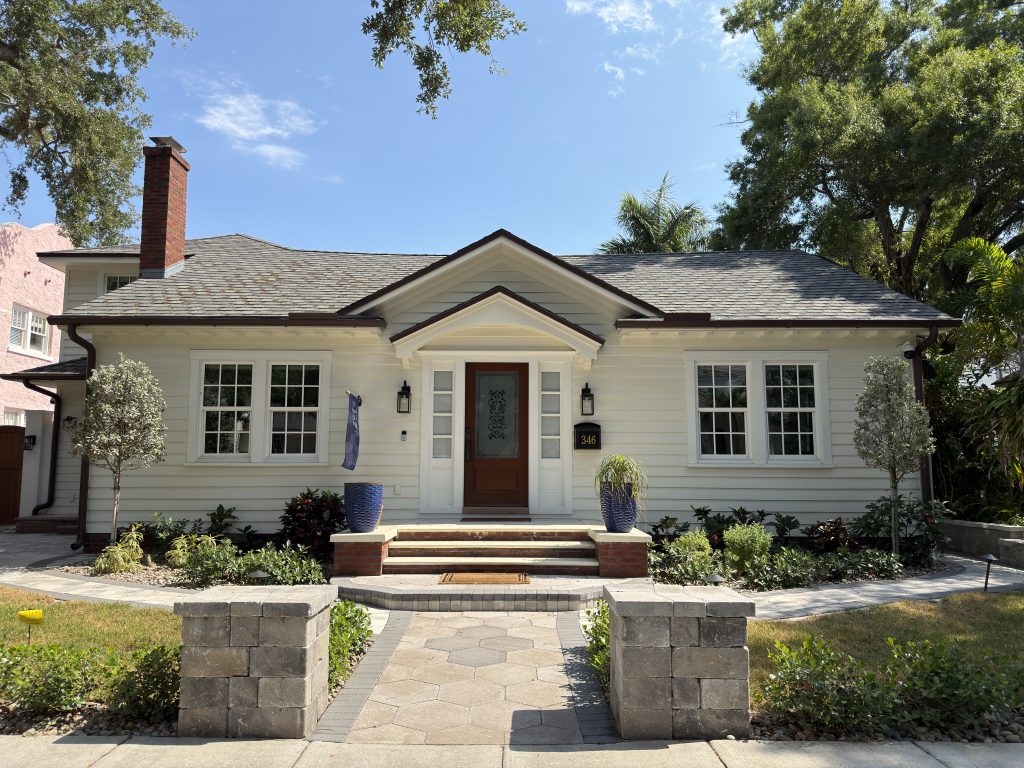
I want to begin by being clear about what this house is, because the legend often runs ahead of the documentation, and the truth is more interesting than the myth.
The Craftsman bungalow at 346 16th Avenue Northeast in St. Petersburg’s Historic Old Northeast neighborhood is one of approximately fifteen documented or attributed addresses where Babe Ruth lived, slept, or stayed during his fifteen Yankees spring training seasons in St. Petersburg between 1925 and 1935. Of those fifteen-plus addresses — which include hotels (the Vinoy, the Don CeSar, the Jungle Country Club Hotel), apartments (the Snell Isle Apartments, the Flori de Leon penthouses he reportedly shared the same building with Lou Gehrig), and various rental homes scattered across the city — 346 16th Avenue NE is the one for which the documentary record is clearest. It is the Babe Ruth Old Northeast bungalow whose 1935 lease was reported in the St. Petersburg Times of the day, whose 1969 St. Petersburg Times article preserved the recollections of the original landlord, and whose 2025 restoration by historic preservationist Maureen Stafford has brought the property back into the public consciousness as one of the most genuinely consequential historic homes in St. Petersburg.
I photographed this home recently. The bungalow stands on its quiet residential street between 3rd and 4th Streets, set back behind mature landscaping, the Craftsman porch deep and shaded, the front facade displaying the careful preservation work that has occupied a portion of the past several years. Standing in front of it on the kind of soft St. Petersburg afternoon when the light begins to warm into amber color, I found myself thinking about what 1935 actually meant for Babe Ruth, and what it means for the historic homes of Tampa Bay that one of them happened to host him during what turned out to be the final spring training season of the most consequential career in American baseball history.
What follows is the most complete account I have been able to assemble of this specific home, this specific season, and what they together represent.
The 1924 Bungalow
The home was built in 1924 — one year after the construction year that defines so much of the Old Northeast’s residential fabric and during the height of the Florida Land Boom that transformed St. Petersburg from a small coastal town into one of the fastest-growing cities in the United States.
It is a textbook Craftsman bungalow of its era. Approximately 1,700 square feet of living space distributed across a single primary floor with the characteristic wood-frame construction, wooden siding, shingled roof, and the deep front porch that defines the style. Three bedrooms, three bathrooms, the kind of intimate scale that the early-twentieth-century American residential architecture produced before postwar expectations inflated typical home sizes. Original details that survive include crown molding throughout, a Rumford fireplace (the design developed by Sir Benjamin Thompson in the eighteenth century, characterized by tall, shallow fireboxes that throw heat efficiently into the room), and white oak flooring.
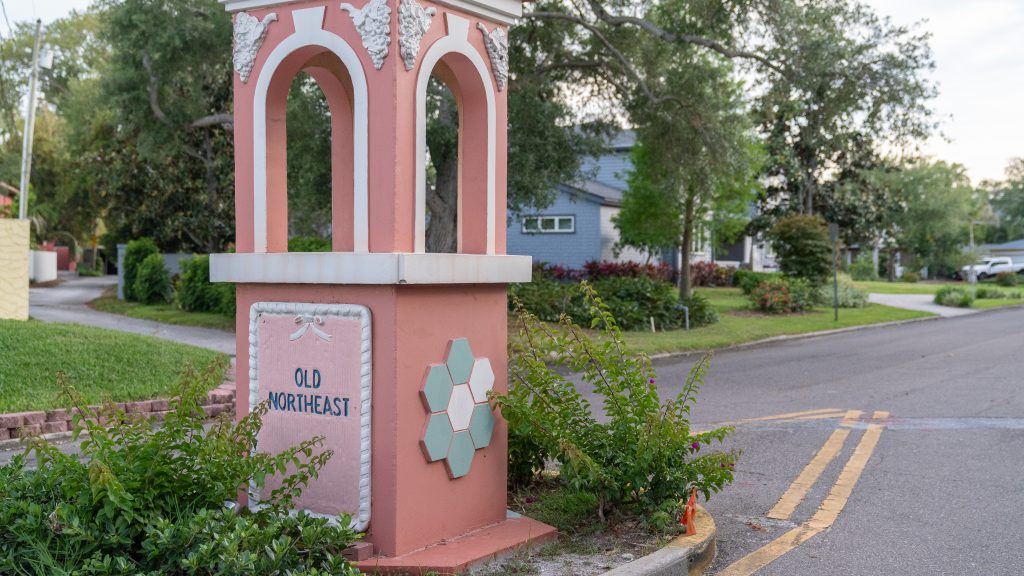
The property sits on a 0.15-acre lot in the heart of the Old Northeast residential grid, just blocks from Tampa Bay to the east and a short walk from Crescent Lake Park to the north. The neighborhood itself was, by 1924, well into its development as one of St. Petersburg’s most architecturally distinguished historic districts — the brick streets, hexagonal sidewalks, granite curbstones, and the consistent residential character that continues to define the Old Northeast today were largely in place by the time this home was built.
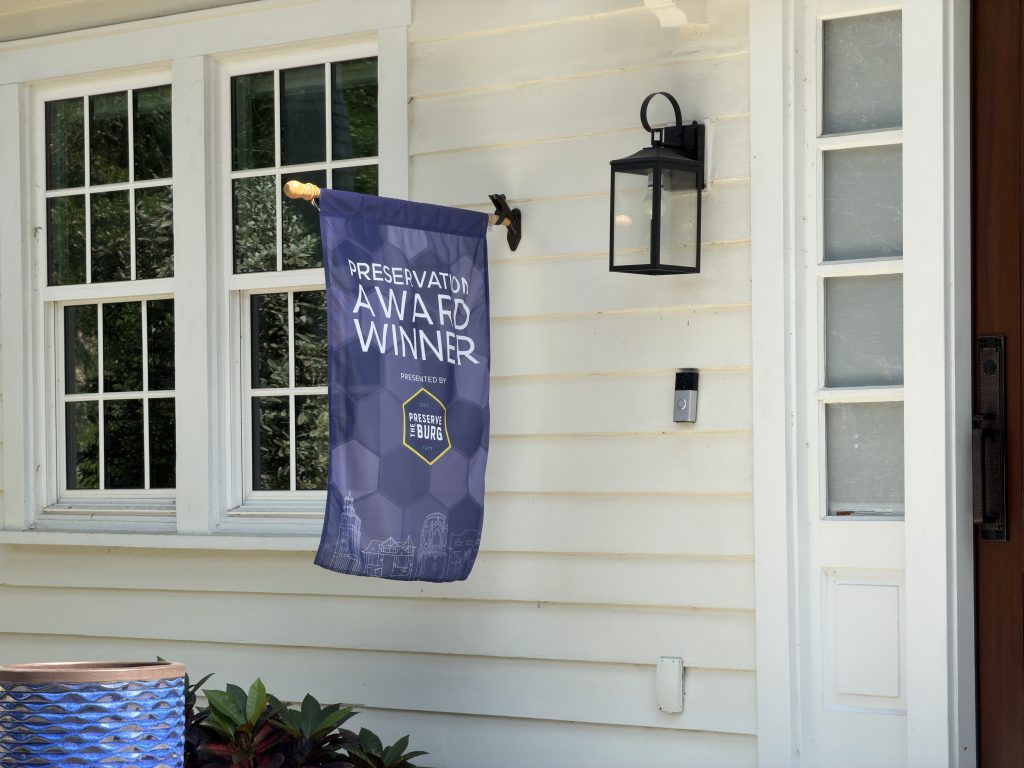
What makes this Craftsman bungalow architecturally significant beyond its style is the combination of original character and recent thoughtful preservation. By the early 2020s, the home had fallen into substantial disrepair. According to news coverage of the 2024-2025 restoration, the property was overcome with mold and structural damage to the point that conventional builders would have preferred to demolish it rather than restore it. The home’s salvation came through the work of Maureen Stafford, an award-winning historic preservationist who has lived in the Old Northeast since the 1990s and completed more than thirty historic preservation projects in the neighborhood and beyond.
Stafford spent approximately three and a half years on the restoration. The work was comprehensive — bringing the home into compliance with modern hurricane and code requirements while preserving the original architectural character and as many of the historic features as could be saved. The crown molding remained. The Rumford fireplace remained. The white oak floors were preserved. The deep Craftsman porch, the wood siding, and the foundational architectural elements that define the bungalow as a historic home all survived through the work of craftsmen who understood what they were preserving.
The result is a 1,700-square-foot historic bungalow that meets contemporary building code, can withstand the storm conditions that have become increasingly central to Florida real estate considerations, and retains the architectural character that connects directly to the home’s original 1924 construction and its 1935 moment of historical significance. Few historic Florida homes have benefited from this level of preservation work. The fact that this particular home received it reflects both Stafford’s commitment to the neighborhood and the specific weight of what this home represents.
The Two Notable Owners
The home’s documented history connects to two men whose names appear repeatedly in the early-twentieth-century Tampa Bay record.
George Gandy Sr. owned the property during portions of the 1920s and 1930s. Gandy is the figure who gave the Gandy Bridge its name — the first vehicular bridge to span Tampa Bay, connecting Tampa and St. Petersburg directly across the water for the first time. Before the Gandy Bridge opened to traffic in 1924, travel between the two cities required either a long drive around the bay through Oldsmar and Tampa or a ferry crossing. Gandy financed and built the bridge personally — paying approximately $3 million at the time, equivalent to roughly $56 million in 2026 dollars, with 1,500 workers completing the 2.5-mile span. The original bridge was replaced in 1956, expanded in 1976, and expanded again in 1996, but the name has remained constant. Every time someone in Tampa Bay refers to the Gandy or crosses it, they are invoking the man who once owned the home at 346 16th Avenue NE.
That a single historic home in St. Petersburg’s Old Northeast was once the residence of one of the city’s most consequential infrastructure pioneers, and was subsequently rented by perhaps the most consequential American baseball figure of the twentieth century, places the property in a documentary category that few homes anywhere in Florida can match.
Babe Ruth rented the home during the spring of 1935. Ruth’s connection to St. Petersburg specifically began in 1925, when the New York Yankees moved their spring training operations to the city following the construction of what would become Huggins-Stengel Field at Crescent Lake Park. From 1925 through 1934, Ruth trained each February and March in St. Petersburg as a Yankee, and the city became the secondary home for one of American sports’ most outsized personalities during the most prolific decade of his career. He played at Huggins-Stengel through the seasons that produced his career-defining home run records. He stayed in various St. Petersburg residences across these years — sometimes in hotels, sometimes in apartments, sometimes in rental homes like 346 16th Avenue NE.
What makes the 1935 season specifically significant is that it was Ruth’s final major league season — and crucially, his final season as a Yankee was 1934. In 1935, he played for the Boston Braves of the National League, having been released by the Yankees following the 1934 season. The 1935 spring training was therefore his final spring training as an active player, and his arrival in St. Petersburg during that February with his second wife Claire and his stepdaughter Dorothy carried a different weight than his earlier visits. The man who had defined Yankee baseball for a decade was now training with a different team in what would become his final professional season.
He hit his final three career home runs on May 25, 1935, in a single game in Pittsburgh — a remarkable closing performance that included his 714th and final career home run, a then-record that stood for nearly forty years until Henry Aaron broke it in 1974. He retired from baseball on June 2, 1935, weeks later. The 1935 spring training season at 346 16th Avenue NE was, in this sense, the last preparation he ever undertook for a major league season.
The original landlord Harry Woods, in a 1969 St. Petersburg Times interview, recalled renting the home to Ruth, his wife Claire, and his stepdaughter Dorothy. Woods also reported finding a whiskey bottle hidden under the floorboards during subsequent work on the property — a small archaeological detail that he attributed, plausibly enough, to the Babe.
The Larger Babe Ruth Tampa Bay Story
To understand what 346 16th Avenue NE represents, it helps to understand the broader story of Babe Ruth’s relationship with St. Petersburg.
Ruth came to the city as a Yankee in 1925, two years after the team moved its spring training operations to the new ballfield at Crescent Lake Park that the city had built specifically to house major league spring training. The decision to bring the Yankees to St. Petersburg was driven by Perry Snell, the master developer who would also create Snell Isle. Snell sold 56 acres of land at a discounted price to the City of St. Petersburg in 1919 with the condition that the land be used to build a public park and a baseball field. The park and ballfield opened in 1925 — making Huggins-Stengel Field one of the oldest continuously operating baseball fields in the United States.
The Yankees trained at Huggins-Stengel from 1925 through 1961 — thirty-six consecutive seasons in which the most storied franchise in American baseball prepared each February and March in this small St. Petersburg neighborhood. The roster of players who worked at Huggins-Stengel reads like a summary of twentieth-century baseball: Ruth, Lou Gehrig, Joe DiMaggio, Yogi Berra, Mickey Mantle, Whitey Ford, Casey Stengel (the field’s namesake and longtime Yankees manager), Miller Huggins (the other namesake and Ruth’s manager during the prime Yankees years).
Ruth was the most outsized of these figures, both in talent and in the various theatrical aspects of his personality that defined his public image. He brought what one chronicler has called “Ruthamania” to St. Petersburg, attracting fans, photographers, and the kind of media attention that helped transform the city from a small coastal town into a known destination on the American sports map. The fifteen spring training seasons he spent in St. Petersburg between 1925 and 1935 (with the 1925-1934 seasons as a Yankee and the 1935 season with the Braves) embedded him deeply in the city’s social and architectural fabric.
He stayed across many addresses during these fifteen years. The Vinoy Hotel on the bayfront. The Don CeSar on St. Pete Beach. The Jungle Country Club Hotel (now Admiral Farragut Academy) on the western side of St. Petersburg. The Flori de Leon downtown, where he and Gehrig reportedly rented dueling penthouses on the upper floors. Various individual rental homes in the Old Northeast and surrounding neighborhoods, some of them documented and some of them surviving only as informal local lore. A notable Yankee log cabin clubhouse stood at 746 14th Avenue NE in the Old Northeast until its 2004 removal.
Of all these locations, 346 16th Avenue NE is the most thoroughly documented as a specifically rental residence — with the contemporary 1935 St. Petersburg Times reporting confirming the address, Harry Woods’s 1969 recollection of the lease arrangement, and the continued local tradition of the property’s identification as the Babe Ruth bungalow.
The Old Northeast in 1935
The 1935 St. Petersburg in which Babe Ruth rented this Craftsman bungalow was a specific city in a specific moment, and worth understanding to grasp the home’s context.
The Florida Land Boom of the 1920s had collapsed by 1928, six years before the bungalow at 346 16th Avenue NE was built but well before Ruth rented it. The Great Depression that began in 1929 had hit Florida hard, with property values crashing, construction halting across most of the state, and the substantial wealth that had flowed into Tampa Bay during the boom years effectively disappearing from local circulation. The Yankees’ continued spring training presence in St. Petersburg through this period was one of the few reliable sources of seasonal economic vitality during the Depression years.
The Old Northeast residential fabric that had been substantially built by the late 1920s was already historic by 1935 standards — the homes were ten to fifteen years old, the neighborhoods were established, and the architectural character that continues to define the district today was largely in place. The 1935 Craftsman bungalow that Ruth rented was therefore a relatively new home in an established neighborhood, situated within a few blocks of Tampa Bay’s waterfront, within walking distance of Crescent Lake Park and Huggins-Stengel Field, and within a community that was both proud of its architectural distinction and accustomed to hosting visiting Yankees players each spring.
The neighborhood’s hexagonal sidewalks were already in place. The brick streets had been laid. The granite curbstones had been installed. The mature oaks that today form the canopy above the Old Northeast’s residential streets were younger then, but already present and already shading the streets. Babe Ruth, walking from 346 16th Avenue NE to Huggins-Stengel Field roughly a mile away, would have walked the same hexagonal sidewalks beneath the same oaks (or their immediate predecessors) that residents and visitors walk today. The continuity of the neighborhood’s physical fabric across the past ninety years is genuinely remarkable.
The Photographs and What They Captured
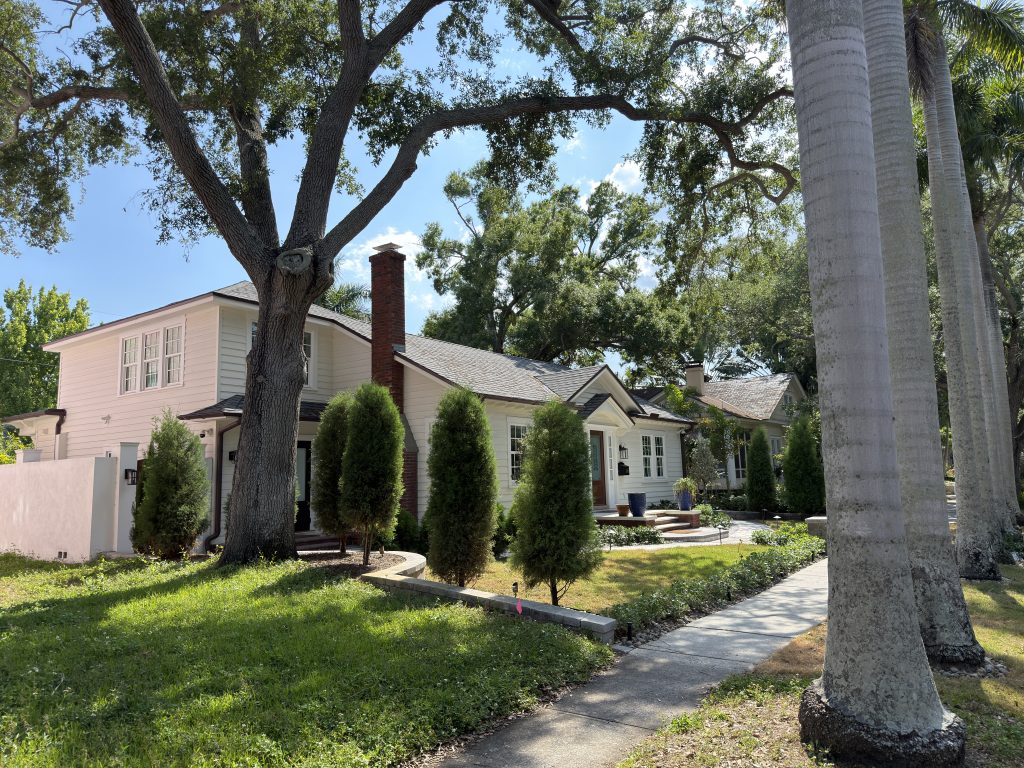
I want to share something about the photographs of this home that I recently took.
The bungalow is set back from the street behind mature landscaping. The deep Craftsman porch creates the kind of shaded entry that defines the style. The wood siding has been recently restored and painted. The shingled roof shows the careful attention to architectural detail that characterized the Maureen Stafford restoration work.
But what struck me, photographing the home in the late afternoon, was not the architectural detail per se. It was the cumulative weight of what this small Craftsman bungalow has carried across its hundred-plus years of existence. Built in 1924 during the boom era. Owned by the man who built the bridge connecting Tampa and St. Petersburg. Rented to Babe Ruth during the final spring training season of his major league career. Survived the Depression, World War II, the postwar transformation of Florida, multiple ownership transitions, decades of Florida storms, the gradual neighborhood changes of seventy years, and finally the recent threat of demolition that nearly ended the home’s existence.
It is a small home. It is not a Mediterranean Revival estate or a Snell Isle waterfront landmark. It does not announce its significance in the way that some Old Northeast residences announce theirs. But it has been the witness to a hundred years of specific, documentable history, and it has emerged from that history substantially intact — through the work of preservationists, owners, and craftsmen who understood that some homes deserve to be saved.
This is what historic homes actually are, in the end. They are not objects of nostalgia. They are physical records of specific human lives that intersected with specific moments. The bungalow at 346 16th Avenue NE is one of these records. The fact that it survives, restored and inhabitable, is an act of cultural continuity that few American communities would have managed, and that we should not take for granted.
The Crescent Lake Connection
I want to close by noting something that connects this home directly to my broader work in this Journal.
The Crescent Lake neighborhood — covered in detail in my recent Journal piece on Crescent Lake — sits roughly half a mile north of 346 16th Avenue NE, with Huggins-Stengel Field at its southern edge. The walk from Ruth’s 1935 spring training rental to the field he played on is short, easy, and follows the same residential streets and the same hexagonal sidewalks that residents of both neighborhoods walk today.
The Babe Ruth house and Huggins-Stengel Field are not separate historical artifacts. They are two ends of the same daily routine that one of American baseball’s most consequential figures actually walked during the spring of 1935. This is what historic neighborhoods preserve when they are preserved well — not just individual landmark buildings, but the connecting tissue between buildings that allowed specific human lives to take shape. Ruth’s spring 1935 routine is gone, of course. But the streets on which it took place remain. The home where he slept remains. The field where he trained remains. The neighborhoods that connected them remain. A century later, walking these streets is genuinely walking through a continuing piece of American sports and architectural history.
For anyone visiting St. Petersburg with serious interest in Babe Ruth’s specific footprints — or in the broader story of how the Yankees transformed the city’s identity during the 1920s and 1930s — the Old Northeast residential streets and Crescent Lake Park together constitute one of the most genuinely consequential walking tours available in any American city. The bungalow at 346 16th Avenue NE is one essential stop. Huggins-Stengel Field is another. The Flori de Leon at 130 4th Avenue North, where Ruth and Gehrig reportedly rented penthouses, is a third. The Vinoy Park Hotel on the bayfront, where Ruth occasionally stayed and which now operates as the Vinoy Resort, is a fourth.
Walking these locations in sequence, on a soft St. Petersburg afternoon, with attention to what each one actually represents, is one of the more meaningful experiences this neighborhood offers anyone who cares about the intersection of architecture, community, and American history.
Considering an Old Northeast Historic Home?
The Babe Ruth house at 346 16th Avenue NE is one of approximately 270 contributing structures within the broader Historic Old Northeast district, and one of thousands of historically significant residences across the Tampa Bay region that I work with in my real estate practice. For readers considering a historic home purchase in the Old Northeast, in nearby Crescent Lake, or in any of Tampa Bay’s other historic neighborhoods, I would welcome the conversation.
For the broader context on the Old Northeast and Crescent Lake neighborhoods specifically, my Journal piece on Crescent Lake covers the related history at greater length. For the architectural and historical depth on the broader Tampa Bay historic homes landscape, the Journal archive offers extensive additional resources.
Call 727-871-SOLD (727-871-7653) or reach out through the Contact page to start the conversation.