From sponge boats and Greek traditions to historic homes, Gulf beaches, and one of North Pinellas County’s most distinctive places
By Mark Middleton
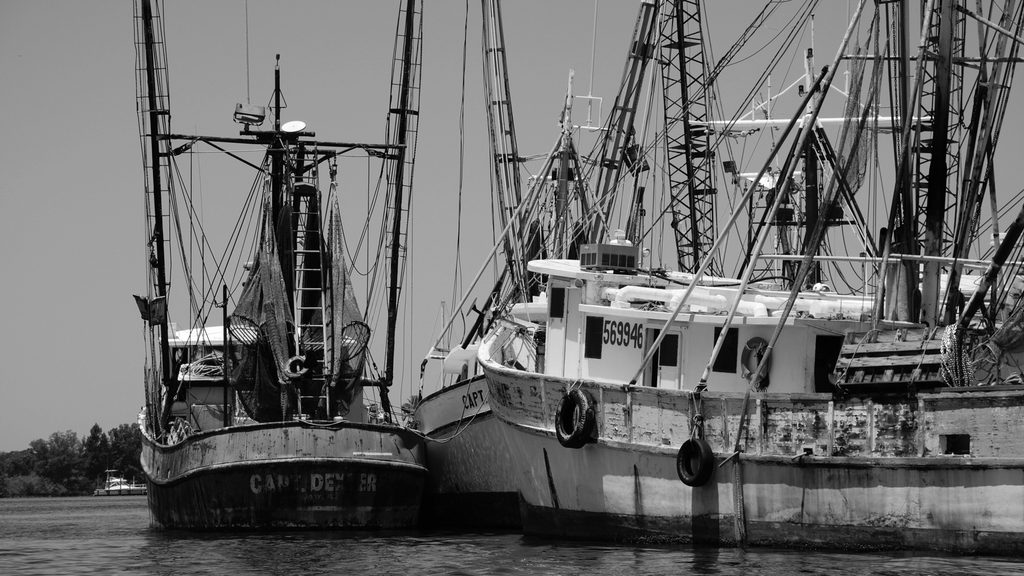
I photographed these working boats on the Anclote River in 2007. They are gone now, which is one of the reasons I have come to appreciate photography as a way of preserving the places we assume will always look the same.
There are places you discover once, and there are places you grow up alongside. Tarpon Springs has always been the latter for me. I first began spending time here while I was still in high school in the late 1980s, and even then, a trip north to Tarpon Springs felt different from almost anywhere else in Pinellas County. The streets were older, the waterfront had its own rhythm, Greek was spoken around the Sponge Docks, and the restaurants felt like places that belonged to families rather than chains. There was a sense, even then, that the city knew exactly what it was.
More than three decades later, I still feel that way. A lot has improved. Downtown has become more interesting, the restaurant and brewery scene has expanded, historic buildings have found new uses, and there are more reasons than ever to spend an entire day here. What has not disappeared is the identity underneath it all. Tarpon Springs still feels like Tarpon Springs, and in Florida, that is more important than it sounds.
Throughout the state, communities have grown so quickly that it can sometimes become difficult to tell where one city ends and another begins. Tarpon Springs never quite surrendered to that sameness. Its history is too visible, its Greek culture too deeply rooted, and its relationship with the Anclote River and Gulf too important to be hidden by another shopping center. If you are thinking about visiting, buying a home here, selling one, or simply trying to understand why people become so attached to this city, the best place to begin is not with real estate. It is with the water.
Before the Sponge Docks Became an Attraction
The story most people know about Tarpon Springs begins with sponges, although the community itself existed before the Greek sponge divers arrived. Tarpon Springs was incorporated in 1887, making it the oldest incorporated municipality in what is now Pinellas County. That same year, the railroad reached the community, the Anclote Key lighthouse was completed, and the town continued developing as both a winter destination and a working waterfront community.
Sponging in the waters off Florida’s west coast began developing in the late nineteenth century. John K. Cheyney launched one of the area’s early sponge-fishing operations around 1890, when sponges were generally retrieved using hooks. The industry changed dramatically in 1905 when John Cocoris, a Greek immigrant familiar with Mediterranean sponge-diving techniques, helped introduce hard-hat diving to Tarpon Springs. The new method allowed divers to work in deeper water and harvest far more effectively.
Greek divers and their families began arriving in increasing numbers, many from the Dodecanese islands and other parts of Greece. They did not simply bring a different way to collect sponges. They brought language, religion, food, music, family traditions, and a culture that would eventually become inseparable from the identity of the city. The Tarpon Springs Sponge Exchange was incorporated in 1908, creating a central place for storing and selling the harvest, and by the 1930s the sponge industry had reached its peak.
It is easy now to walk Dodecanese Boulevard, browse the shops, stop for lunch, and think of the Sponge Docks primarily as a visitor destination. That is not what created them. They were part of an industry. Boats left the river because people made their living on the Gulf. Divers worked in dangerous conditions. Sponges came ashore, were cleaned, sorted, and sold, and an economy grew around something most of us now encounter as a souvenir in a basket. The tourism came later.
The Photograph That Means More to Me Now
This is one reason the black-and-white photograph at the beginning of this article means more to me today than it did when I made it in 2007. I was photographing the boats along the Anclote River because I liked the lines, the rigging, and the visual clutter of a working waterfront. At the time, there was no reason to think those particular boats would not still be sitting there years later.
They are gone now, and that changes the photograph. It does not make it historic in the sense of something made a century ago, but it does make it a record of a waterfront that has already changed. I have learned this repeatedly through photography. We tend to photograph things once they are officially considered important, when in reality an ordinary street corner, storefront, fishing boat, or house may become historically meaningful simply because someone bothered to record it before it disappeared.
Tarpon Springs is especially good at reminding us of that. The working waterfront continues, but it changes. Boats leave, businesses close, families pass a restaurant to another generation, and buildings acquire new uses. A scene that feels permanent slowly becomes something else, which is why I have come to believe that documenting a place matters.
Greek Culture Here Is Not Decoration
One of the easiest mistakes a visitor can make is treating Tarpon Springs’ Greek identity as a theme created around tourism. It is not. The first Greek immigrants who arrived to participate in the sponge industry established families, businesses, churches, and institutions. St. Nicholas Greek Orthodox Church was originally built in 1907, only two years after the large-scale arrival of Greek sponge divers. As the community grew, the present St. Nicholas Greek Orthodox Cathedral was completed in 1943, supported in part by sponge divers who contributed portions of their harvest to the church.
That relationship between religion, maritime work, and community helps explain why St. Nicholas remains so central to Tarpon Springs. The clearest example is Epiphany. Each January, the celebration begins at the cathedral and continues with a procession to Spring Bayou, where a cross is cast into the water and young men dive to retrieve it. Thousands of people may attend, but the event is not primarily a spectacle created for visitors. It is a religious tradition that has been part of Tarpon Springs for more than a century.
The restaurants, bakeries, and markets around the Sponge Docks also make more sense once you understand that many emerged from the needs of an actual Greek community rather than being added later as entertainment. The Sponge Docks became a place where visitors could experience a culture that already existed, rather than a culture invented for visitors. That authenticity is one of the reasons Tarpon Springs remains distinctive.
A More Complete History
Another part of the story deserves more attention. The earliest commercial spongers in the region were not Greek. Afro-Bahamian and other Black spongers were working the Gulf waters before the introduction of Greek hard-hat diving, using long hooks and glass-bottom buckets to locate and retrieve sponges in shallower water.
Tarpon Springs has done more in recent years to acknowledge that earlier chapter. The city’s public art program includes work recognizing African American and Afro-Bahamian spongers and their role in the industry from the late nineteenth century into the twentieth. That makes the history more complete, and it is important because a community is rarely shaped by one migration, one family, or one industry. Tarpon Springs is fascinating precisely because so many layers are visible at once.
Downtown Tarpon Springs Deserves Its Own Afternoon
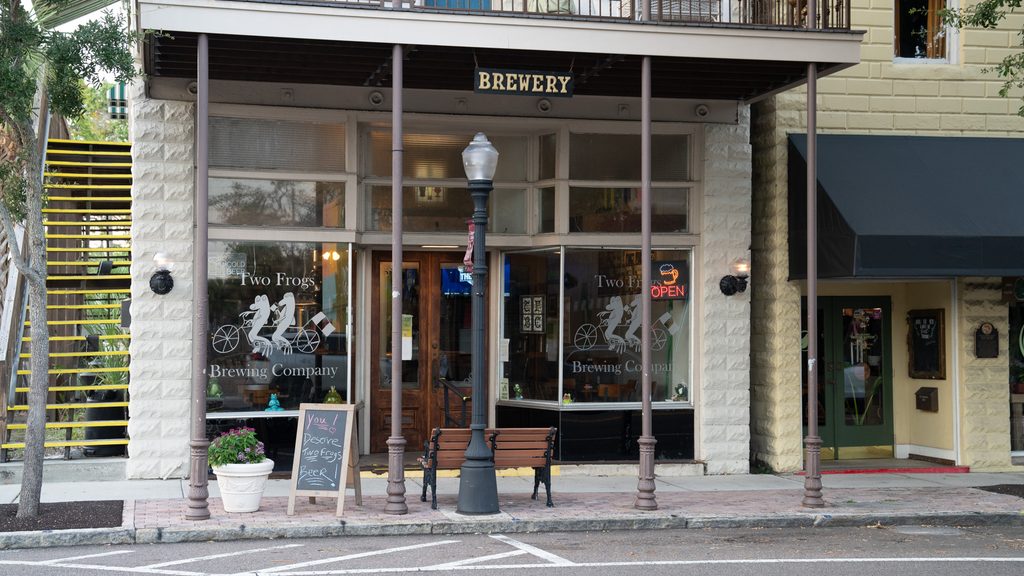
Downtown Tarpon Springs has become increasingly interesting over the years, with restaurants, breweries, shops, and older buildings giving Tarpon Avenue an identity distinct from the Sponge Docks.
The Sponge Docks get most of the attention, but downtown Tarpon Springs should not be treated as the place you drive through on the way there. I have watched downtown evolve for decades, and I think it is better now than it has ever been.
Tarpon Avenue and the surrounding streets contain restaurants, bars, breweries, galleries, antique shops, specialty stores, and businesses occupying buildings that still retain a sense of the city’s earlier scale. Two Frogs Brewing, pictured here, is a good example of the kind of small local business that fits the setting rather than overwhelming it.
One of the things I enjoy about downtown is that it feels different from the Sponge Docks even though the two are only minutes apart. The Docks are louder, more crowded, and more obviously connected to tourism. Downtown has a different rhythm. It is somewhere you might go for dinner on an ordinary Thursday, meet someone for a beer, browse an antique shop, or walk for an hour without feeling that you are checking off attractions.
For someone considering living in Tarpon Springs, this distinction matters. You are not buying a house in a tourist destination. You are buying into a city that people actually use year-round.
A Historic District You Can Still Read From the Street
Tarpon Springs also has one of North Pinellas County’s most substantial collections of older residential and commercial buildings. The Tarpon Springs Historic District was listed on the National Register of Historic Places in 1990, and the district includes architecture associated with the development of the city before and during the rise of the sponge industry.
What makes that especially rewarding is how much can still be experienced on foot. Walk around Spring Bayou, South Spring Boulevard, and the surrounding blocks and you begin encountering houses that make the city’s history tangible. There are frame vernacular homes, Victorian-era buildings, bungalows, and revival-style residences from different periods.
You do not need an architectural degree to notice that these streets feel different. The setbacks change. Porches matter. Windows are taller. Rooflines become more complicated. Mature trees soften the street, and the relationship between the houses and Spring Bayou creates a setting unlike almost anywhere else in Pinellas County.
The Knapp House and Spring Bayou
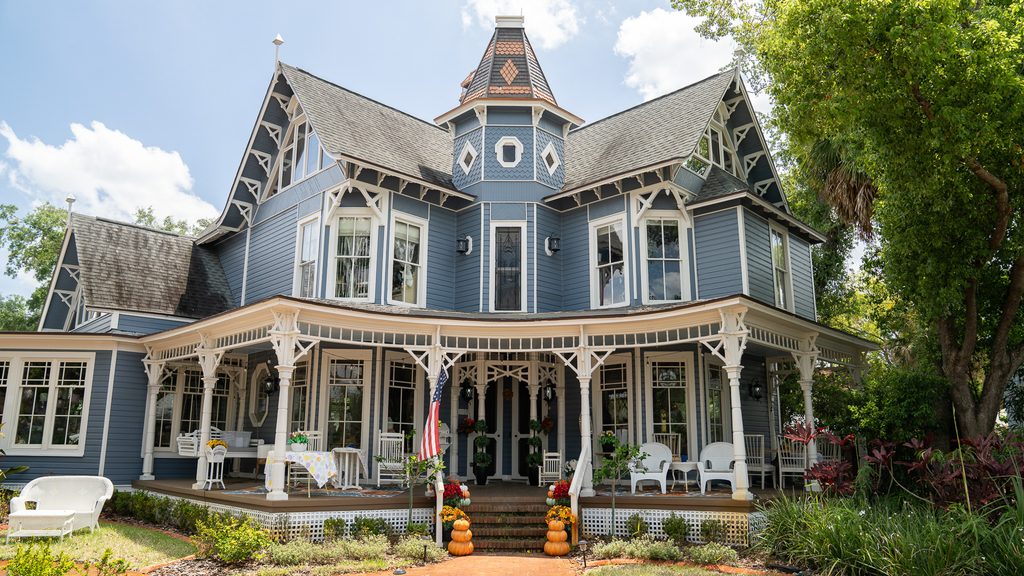
The Knapp House at 115 South Spring Boulevard, sometimes called the Crescent House, is one of Tarpon Springs’ most recognizable historic residences and overlooks Spring Bayou.
One of the homes I have written about separately at Historic Homes Tampa Bay is the Knapp House at 115 South Spring Boulevard. It is difficult to miss. The large Queen Anne Revival house rises above the street with an elaborate roofline, tower, decorative millwork, and a sweeping porch facing Spring Bayou. It is the kind of house that can make someone stop walking simply to take it in.
I have known the house for years, but photographing it and studying its history made me appreciate how much one building can witness. From that porch, generations of owners have looked toward the same bayou where the Epiphany procession arrives each January. The neighborhood around it has changed, automobiles replaced earlier forms of transportation, and Tarpon Springs grew from a small Gulf Coast community into a much larger city. The house remained.
I wrote a much deeper history of the property in The Knapp House at 115 S. Spring Boulevard: Tarpon Springs’ Oldest Witness, and I have also written about what it feels like simply to walk this part of town in Walking Spring Bayou: An Evening in Tarpon Springs’ Historic Heart. If you want to understand historic Tarpon Springs, this is where I would spend some time. Do not drive through it. Walk.
The Beach Is Part of Tarpon Springs Too
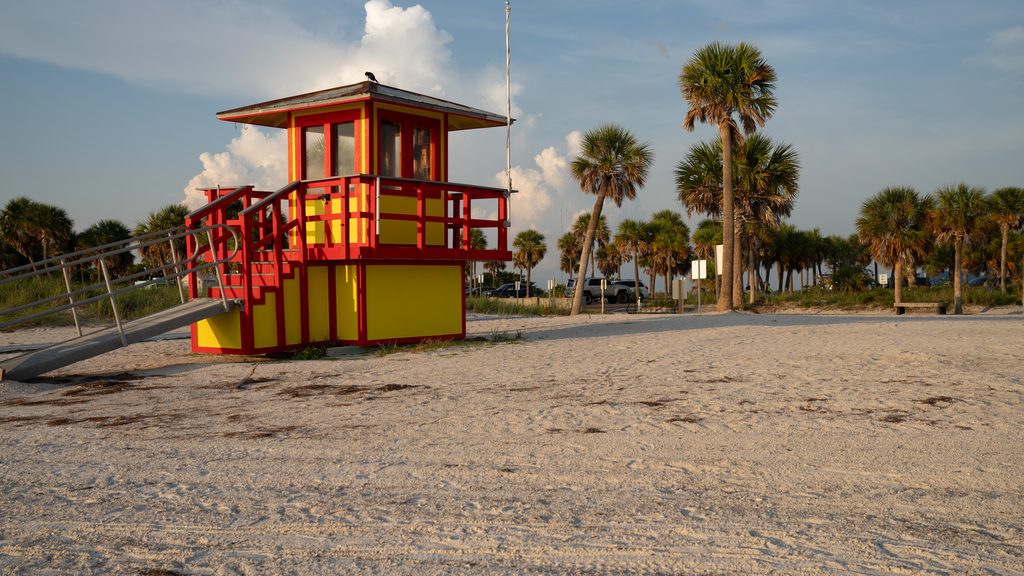
Fred Howard Park is one of the places that changes the way people think about Tarpon Springs. The city is not only a historic waterfront community. It also has direct access to a Gulf beach.
One of the things visitors sometimes overlook is that Tarpon Springs has its own beach experience. Fred Howard Park sits west of the residential neighborhoods at the end of Sunset Drive and includes approximately 155 acres, with a mile-long causeway extending from the mainland portion of the park to a white-sand beach on the Gulf.
It is one of my favorite places in North Pinellas because the drive out to the beach is part of the experience. As you cross the causeway, land begins falling away on both sides and the horizon opens. For a moment, the city disappears. Then you reach the beach.
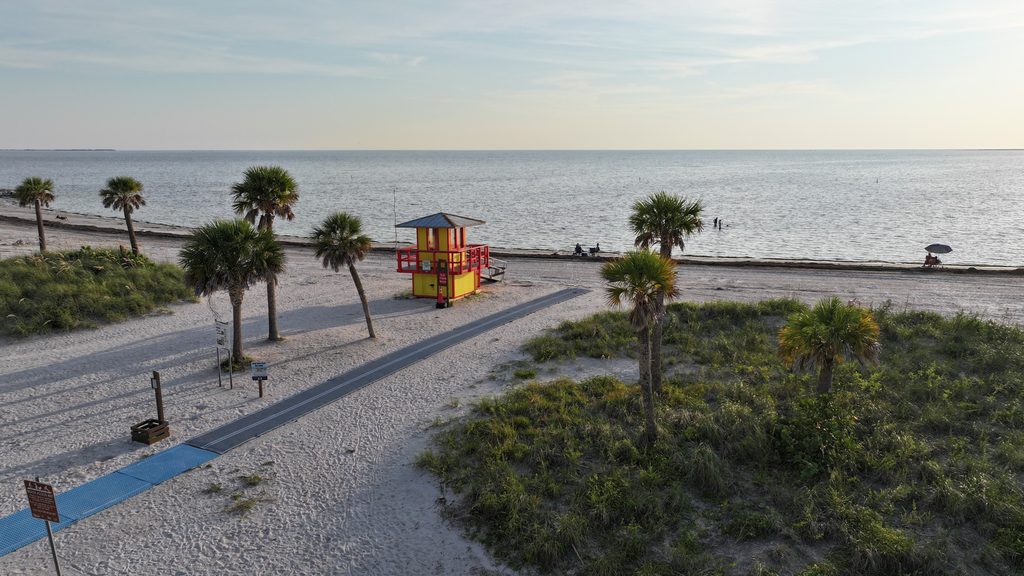
The causeway and beach at Fred Howard Park give Tarpon Springs a direct relationship with the Gulf that influences both the lifestyle and the housing market.
For someone considering buying a home here, proximity to Fred Howard can matter more than it might appear on a real estate map. A house does not have to be beachfront for the beach to become part of everyday life. That is something people relocating to Florida sometimes underestimate. The value of living near the coast is not always the view from your bedroom window. Sometimes it is being able to finish work and be standing beside the Gulf twenty minutes later.
Tarpon Springs Is Still a Working Coastal City
Another reason I like Tarpon Springs is that it has never been reduced entirely to tourism. The Anclote River remains active with fishing vessels, recreational boats, commercial activity, and marinas. Offshore sits Anclote Key, whose lighthouse and barrier-island landscape offer yet another side of the area.
That relationship with the Gulf affects nearly every part of life here. It influences the weather, recreation, property insurance, boating, fishing, flood considerations, and, of course, real estate.
If you are considering buying a waterfront or near-water home in Tarpon Springs, this is where local knowledge becomes especially important. A house on an inland street, a property along the Anclote River, a canal home, and a residence near Fred Howard Park may all be described as coastal, but the ownership experience can be very different.
Flood zones matter, elevation matters, seawalls matter, boat access matters, bridge clearance can matter, and insurance matters. The view is only the beginning.
What It Is Like to Live Here Depends on Which Tarpon Springs You Choose
This is one of the reasons I would never describe Tarpon Springs as one real estate market. There is the historic area near Spring Bayou, the neighborhoods surrounding downtown, waterfront and canal properties along the Anclote River and nearby waterways, postwar residential areas, newer communities, condominium developments, and properties farther east toward U.S. 19.
Those are different housing experiences, and they attract different buyers. The person who falls in love with a late nineteenth-century home near Spring Bayou may not be the person searching for a low-maintenance condominium. The buyer who wants to keep a boat behind the house may place little value on being able to walk downtown.
Good representation begins with understanding that.
Historic Homes Require Different Questions
Historic houses are one of the parts of the market I find particularly interesting. They also require a different mindset.
It is easy to walk into an older Tarpon Springs home and become captivated by heart-pine floors, original windows, decorative millwork, a deep porch, or an unusual floor plan. Those qualities may be exactly what makes the house worth owning, but they are not the only things we need to understand.
Older electrical systems, plumbing, foundations, crawlspaces, roofs, additions, wood-destroying organisms, moisture intrusion, and insurance can all require closer examination. Renovations that occurred decades ago may not have been documented in the same way we expect today. Historic designation is another separate issue. An old house is not automatically designated historic, and a designated property may be subject to requirements that another century-old house is not.
This is one reason I created Historic Homes Tampa Bay as a separate resource devoted to buying, selling, and understanding older properties throughout the region. The goal is never to frighten someone away from an older house. It is to make sure they know what they are buying.
The Restaurants Are Part of the Identity
I cannot write about Tarpon Springs without talking about food. Some of my earliest memories of coming here involve Greek restaurants, pastries, and stopping around the Sponge Docks. That has not changed, although there are considerably more choices now.
Greek food remains fundamental to the city’s identity because it grew from the community itself. Restaurants and bakeries appeared as Greek families established businesses around the sponge industry, and that culinary tradition became one of the ways Tarpon Springs introduced itself to visitors.
Today, you can still spend an afternoon moving between Greek restaurants, bakeries, seafood, bars, and shops around Dodecanese Boulevard, then head downtown and encounter an entirely different restaurant and brewery scene. That combination works because Tarpon Springs did not replace its old identity with something new. It added to it.
Public Art Is Beginning to Tell More of the Story
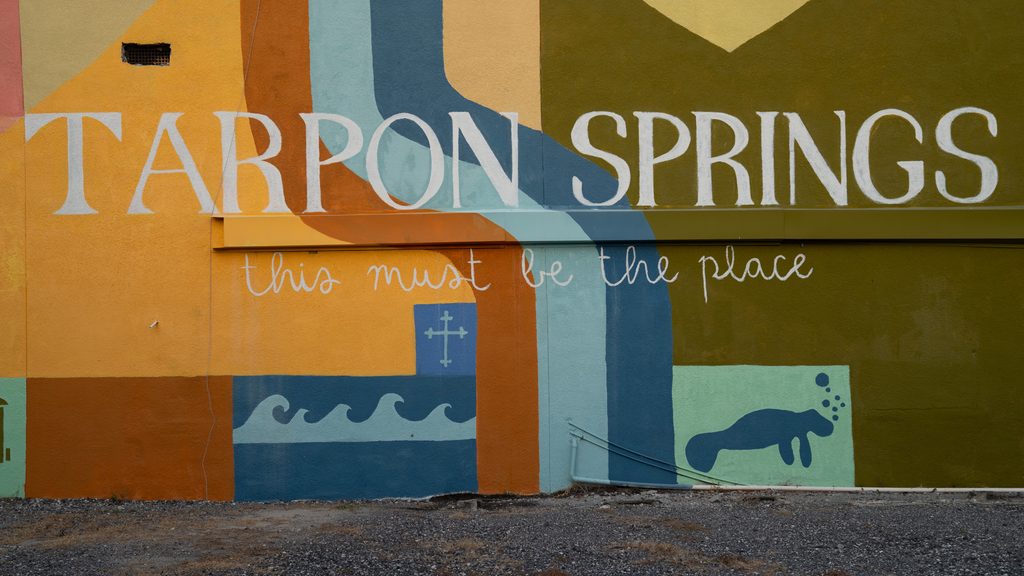
Public art has become another way Tarpon Springs tells its story, extending the city’s identity beyond traditional museums and historic markers.
I am always interested in the way a city tells its story visually. Historic markers are important, but murals and public art reach people differently. You do not need to plan a museum visit to encounter them. They become part of the street itself.
Tarpon Springs has increasingly used public art to recognize different chapters of its history, including stories that were previously underrepresented. I like that approach because history should not always require entering a building. Sometimes it should interrupt your walk.
Tarpon Springs Has Gotten Better Without Becoming Generic
This is what strikes me most after coming here for nearly forty years. Tarpon Springs is better.
There are more restaurants I want to visit, more reasons to spend time downtown, better reuse of older buildings, a stronger appreciation for public art and history, and a wider range of businesses than I remember from decades ago. Yet the city has not erased the things that made it different.
The Greek language still belongs here. Epiphany still belongs here. The Sponge Docks still function as more than a backdrop. Spring Bayou is still one of the most beautiful historic residential settings in Pinellas County. Fishing boats still move along the Anclote, and you can still finish the afternoon at Fred Howard Park and watch the sun drop over the Gulf.
Growth is not automatically the enemy of character. Losing the connection to what came before is.
So far, Tarpon Springs still remembers.
Buying a Home in Tarpon Springs
For buyers, I think the best way to approach Tarpon Springs is to decide which version of the city you actually want. Do you want the history and walkability around Spring Bayou and downtown? Are you looking for waterfront access? Would you rather have a more conventional suburban house with a garage and larger yard? Are you primarily interested in being near Fred Howard Park? Do you want a condominium that allows you to travel without maintaining a large property?
Those are different searches.
Once that question is answered, the due diligence becomes more specific. Older houses raise different concerns from newer construction. Waterfront properties require a different analysis from inland homes. Condominium documents, reserves, insurance, and maintenance obligations deserve their own review.
Real estate becomes much easier to understand once you stop treating every property as interchangeable.
Selling a Home in Tarpon Springs
The same principle applies when I represent a seller. The history of the house matters when it is real and can be documented. Waterfront matters when the buyer can understand what kind of access the property actually offers. Proximity to downtown, Spring Bayou, or Fred Howard Park can matter differently depending on the person likely to purchase the home.
Marketing should communicate those distinctions. Simply putting “Tarpon Springs” in a listing description does not explain why a particular property is worth choosing.
My responsibility as a listing agent is to figure out what makes the house different, photograph it in a way that shows those qualities, tell the story accurately, price it within the market buyers are actually comparing it to, and put that story in front of the right audience.
That is the same philosophy behind Middleton Tampa Bay at Compass, where my work focuses on historic, waterfront, and distinctive properties throughout Tarpon Springs, Dunedin, Clearwater, St. Petersburg, Tampa, and the surrounding communities.
Why I Keep Coming Back
When I think about Tarpon Springs, I do not think first about a list of attractions. I think about years.
I think about driving here when I was young, long before I had any idea that real estate, history, and photography would eventually become so intertwined in my life. I think about the Greek restaurants I have returned to, the streets I have photographed, Spring Bayou in late afternoon light, old houses that somehow survived another decade, and those boats I photographed on the Anclote in 2007 that are no longer there.
Places become meaningful through repetition. You return, notice something different, bring somebody with you, and eventually the place becomes part of your own history as much as you become a witness to its.
Tarpon Springs has done that for me.
After all these years, I still find something worth stopping for.
Thinking About Buying or Selling in Tarpon Springs?
I am Mark Middleton, a Realtor and Broker Associate with Middleton Tampa Bay at Compass, and I have lived in the Tampa Bay area since 1984. Tarpon Springs has been part of my life since my high school years, and today I represent buyers and sellers throughout North Pinellas County, with particular experience in historic homes, waterfront property, and distinctive residences.
If you are thinking about buying or selling a home in Tarpon Springs, I would be happy to help you understand not only the properties available, but the different parts of the city, the history behind them, and the details that can affect ownership and resale. You can learn more about my real estate work through Middleton Tampa Bay, explore my focus on historic and older homes throughout Tampa Bay, read my separate story about walking Spring Bayou and its historic homes, and take a deeper look at the Knapp House at 115 South Spring Boulevard. If you enjoy the broader history and character of the communities I represent, you can also explore Discover Delightful Dunedin, my photography and travel work at Mark A. Middleton, and more of my writing about historic homes, waterfront properties, and distinctive neighborhoods throughout Tampa Bay. For official local information, I also recommend the City of Tarpon Springs, Fred Howard Park, and the Tarpon Springs Historic District. I am Mark Middleton, a Realtor and Broker Associate with Middleton Tampa Bay at Compass, and if Tarpon Springs is a place you are considering calling home, or if you are preparing to sell a property here, I would be glad to help you understand the market, the neighborhood, and what makes your particular home worth noticing.